How to Style a Collected Home

Some rooms look as though they have been assembled all at once. Everything coordinates, every object has an obvious place, and you can almost imagine the shopping list behind it. The rooms I come back to are usually the opposite.

They contain things accumulated at different times and from different places. A piece of studio pottery sits beside something contemporary. An old painting shares a wall with a newer print. There are books, bowls, textiles and slightly strange objects that may have very little in common individually, but somehow make sense together.

Creating that feeling deliberately is harder than it looks. Add too much and the room becomes cluttered. Coordinate everything too closely and you lose the character you were trying to create in the first place.

A useful way to approach it is to build slowly, starting with something old and allowing each new addition to respond to what is already there.

Here are five ways to do it, and fifteen pieces I’d use.
1. Start with something old
Vintage is often the easiest starting point because an old object has already made some of the decisions for you.
Look closely at it. There might be a colour worth repeating, an interesting material to contrast with, or a shape that suggests what should sit beside it. You don’t need to know what the finished room will look like yet.
These three pieces from Smooth Decorator’s current collection would each take a room in a slightly different direction.

The deep oxblood glaze on this signed David Melville stoneware bowl is exactly the sort of colour I like building from.
Rather than trying to find other things in precisely the same red, I’d use it as permission to introduce warmer colours elsewhere: burgundy in a picture, rust in a rug, perhaps a dark reddish wood.
The little white daisy decoration keeps it from feeling too serious, too.
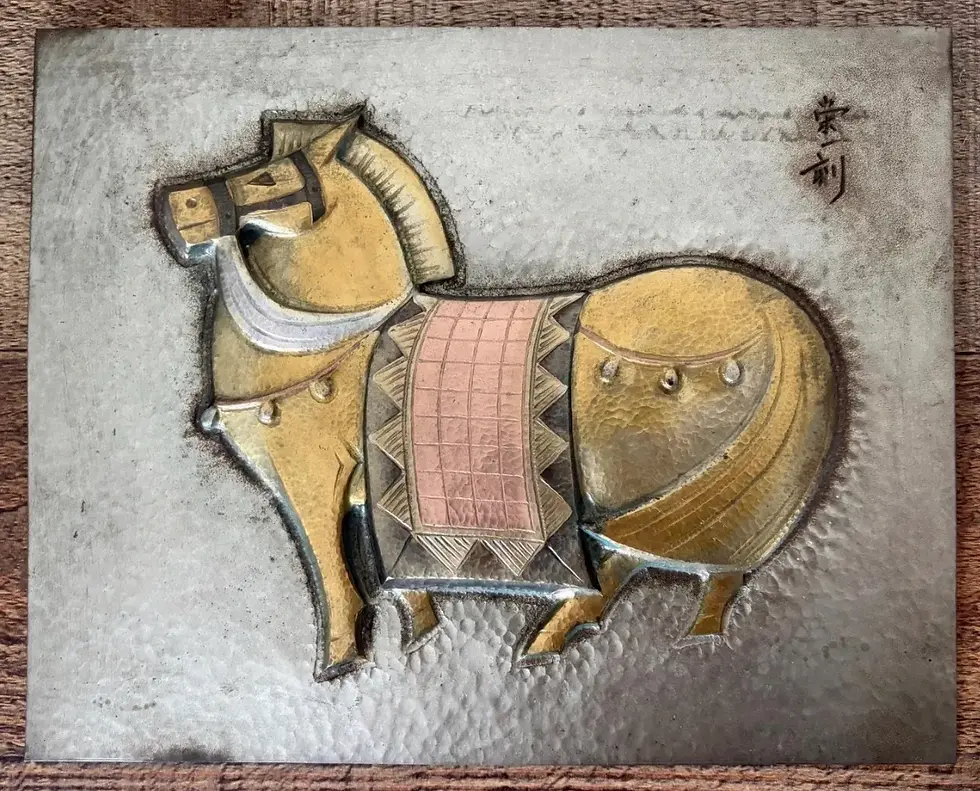
Collected rooms need things that aren’t easily categorised as “home accessories”, and this is one of them.
The small Japanese mixed-metal horse plaque introduces relief, warm metallic tones and something figurative among all the ceramics and glass. I’d hang it as part of a loose picture wall or prop it against the back of a shelf amongst books and other objects.
It is also a useful reminder that art doesn’t always need a frame.

For a subtler starting point, I’d choose this brown and cream studio pottery vase.
The interest is almost entirely in the form and surface: the spiral construction, carved lines and earthy palette. Because of that, I wouldn’t necessarily put flowers in it. An interesting vessel can be an object in its own right.
2. Mix old and new
A collected home doesn’t need to be a vintage home.
In fact, one of the easiest ways to stop a room feeling themed is to put something unmistakably contemporary beside something old.
The connection between them can be quite small. They might share a colour, material or shape. They don’t need to come from the same period or even have the same purpose.

Floral Arrangement Warm - £222
This Floral Arrangement Warm from TROVE & TONE takes something very familiar and makes it slightly strange.
At first glance, it looks like a particularly exuberant arrangement of lilies, poppy, narcissus, anthurium and clover. Look more closely and the flowers are actually made from finely 3D-printed resin, creating a permanent sculptural arrangement rather than a conventional bouquet.

Lara Marquetry Bowl - £400
The Lara Marquetry Bowl from CasaLatina is hand-carved in Venezuela from contrasting tropical hardwoods, using the natural variations in the wood to create its geometric marquetry pattern. At 30cm across, it has enough presence to sit alone on a coffee table or sideboard, and the warm wood works particularly well alongside glazed pottery, coloured glass and darker furniture.

Decorative Round Ceramic Vase - £19.99+
The Decorative Round Ceramic Vase from Zara Home has a low, rounded shape, wavy rim and glazed vertical stripes. I like it as a contemporary counterpart to the older pieces in the room: the irregular form gives it character, while the simple white finish keeps it quiet enough to sit alongside patterned textiles, dark wood and vintage ceramics.
3. Vary the height, shape and texture
When a collection of good objects somehow looks cluttered, the problem isn’t necessarily that there are too many of them.
Sometimes everything is simply occupying the same visual space. Three medium-sized vases lined up beside one another will read very differently from something tall beside a low bowl, with a smaller object raised on a stack of books.
Think about the outline of the arrangement as much as the individual pieces.

H&M Home Stainless Steel Vase - £24.99
This H&M Home vase brings height to the arrangement while keeping the shape simple enough to sit comfortably alongside more characterful vintage pieces. I’d use a taller vase like this at one end of a sideboard or shelf, then bring the eye back down with smaller ceramics and objects around it. The contrast in scale makes even a small collection feel much more considered.

The Frosted Glass Pâte de Verre Footed Plate from TROVE & TONE is handcrafted using traditional glass-fusing techniques, with a raised footed shape and delicate botanical pattern. The translucent, frosted glass gives the arrangement a lighter texture alongside heavier ceramics, while its low, elevated form creates another level without adding another vase.

The Avyn Candle Holder from Nkuku is hand-blown from recycled glass, with a rich forest-green colour and softly irregular form. I like the way the translucent glass adds another texture to a collection of heavier ceramics, while its compact shape creates a lower point beside taller vases and objects.
And don’t forget the things you already own. A horizontal stack of three old books is a display stand. A bowl can sit low beside a tall vase. A small picture can be propped behind both.
You don’t need another object every time you need another level.
4. Bring in art and pattern
Once the surfaces are beginning to come together, look at what is happening behind and around them.
Art is particularly useful because it moves some of the visual interest up the wall. Pattern can then take a few of the colours you’ve established through smaller objects and spread them across a larger area. Neither needs to match.

The Ethereal Hand Painted Canvas from HomeSpace Direct brings a larger, softer artwork into the mix, with its hazy landscape and muted natural tones. I like it alongside smaller vintage pictures and more colourful objects because it gives the eye somewhere quieter to rest, while the hand-painted finish adds texture that a standard print wouldn’t have.

Yaya Silk Ikat Lumbar Pillow - £104
The Yaya Silk Ikat Lumbar Pillow from LOOMY is handwoven in Uzbekistan using traditional ikat techniques, with a rich pattern of brown, black and copper in a 90% silk and 10% cotton weave. Each one varies slightly because of the resist-dyeing process, making it a particularly good way to introduce pattern while keeping the handmade, individual character that works so well in a collected room

Resting in Green by Frances Daws is an original acrylic on canvas built from overlapping shades of green, olive, moss, turquoise and muted ochre. Inspired by the artist’s time spent in the countryside, its loose, organic forms bring colour into the room without introducing a rigid pattern, making it particularly good alongside patterned textiles and more graphic decorative objects. The framed work measures 40.5 × 50.5cm.
5. Finish the room around it
This is the part that is easy to forget.
You can spend ages arranging a shelf or sideboard beautifully, then step backwards and realise you’ve created a very attractive little island that has almost nothing to do with the rest of the room.
So once the smaller arrangement works, stop adding to it. Instead, look across the room and repeat something. It could be a colour, material, texture or shape.

Tillie Chunky Wool Throw - £209
The Tillie Chunky Wool Throw from LOOMY is hand-loomed in Peru from 100% wool, with a thick woven texture and long fringe detailing. The soft ivory colour keeps it understated, while the chunky weave adds warmth and texture alongside smoother materials like glass, glazed ceramics and dark wood.

Botanical Velvet Pillow - £30
The Botanical Velvet Pillow from LOOMY can do more with colour.
Velvet gives you depth and the botanical pattern introduces several shades at once, which makes it useful for connecting colours that appear separately elsewhere.
If there’s green glass on the shelf and a reddish-brown ceramic on the other side of the room, a patterned textile containing both can quietly make the combination feel intentional.

Finally, something very small.
This vintage Matthew Turnbull Windsor glass posy vase has a warm amber colour that would work particularly well with dark wood, cream textiles and earthy pottery.
But I wouldn’t put it with the main collection.
I’d move it across the room: onto a windowsill, bedside table or little occasional table.
Light passing through coloured glass draws the eye, and repeating one of the warmer tones somewhere away from your main arrangement helps connect the two sides of the room.
The collected home
There is no final shopping list that will make a room feel collected.
If anything, the most convincing rooms usually contain things that would look slightly strange if you wrote them down together: a Japanese metal horse, a contemporary resin butterfly vase, an old landscape, a handmade goblet, a patterned cushion and something picked up years ago whose maker you have never been able to identify.
What makes them work is the thread running between them.
Start with something you like. Look at its colour, shape, material and texture. Add something that shares one of those qualities, then something that contrasts with it. Change the scale. Put something old beside something new. Leave enough space for the interesting things to be seen.
Then stop before every empty surface has been filled.
A collected home needs room for the next thing you haven’t found yet.
This post contains affiliate links. If you buy something through one of these links, I may earn a small commission at no extra cost to you.


Comments