Art References at the 2026 Met Gala
The Theme
This year’s Met Gala dress code was Fashion is Art, tied to the Costume Institute’s spring exhibition Costume Art. The instruction to guests was to “express their own relationship to fashion as an embodied art form”. What this produced, across several hundred red carpet looks, was a spectrum running from genuine art historical engagement, to sequins with a vague gesture toward creativity.
The question for me isn’t which outfits looked good, but the strength of their references. Below are the looks that I think are worth looking at, and which show a clear understanding of the works they cited.
A note on context: this year’s gala was co-chaired by Jeff Bezos and Lauren Sánchez Bezos, which generated more protest outside the Met than the theme generated conversation inside it. The art references are still worth examining. But it is worth knowing, before reading, that some of the most considered responses to a night about the relationship between fashion and art were made by people who chose not to show up.
The References

Amy Sherald - Thom Browne Gown - Reference: Miss Everything (Unsuppressed Deliverance) by Amy Sherald (2013)
One of the most interesting looks of the night was worn by Amy Sherald, one of America’s most significant living painters and best known for her portrait of Michelle Obama from 2018. She didn’t reference anyone else’s work at the Met Gala, she wore her own. The Thom Browne look is inspired by her own 2013 painting Miss Everything (Unsuppressed Deliverance).
Miss Everything shows a young Black woman in a navy polka-dot dress, with white gloves and a red fascinator, but the painting is not about the clothes. The subject is rendered with the visual language of formal portraiture. Her grey-toned skin removes colour as a racial category, and her patterned dress and oversized teacup give her a slightly surreal, Alice-in-Wonderland feel which Sherald describes as being about alternative narratives and imagining yourself outside of how the world sees you. Browne’s interpretation sees Sherald in a floor-length wool dress with polka dots, above-the-elbow white leather gloves, and a red fascinator. The three most distinctive visual elements of the original composition are brought to life on the artist herself.
Sherald wearing her own painting is a statement about authorship, whose gaze matters, and the difference between being depicted and depicting yourself. This is especially important at an event which has historically struggled with representing Black women as subjects rather than spectacle.

Amy Sherald, Miss Everything (Unsuppressed Deliverance) (2013), Private Collection.
Law Roach - Ami Paris - Handpainted by Naïla
In a literal interpretation of the theme, Roach, the stylist responsible for many of the most celebrated Met Gala looks of the past decade, wore a custom Ami Paris piece hand-painted by the Gabonese artist Naïla Opiangah. He wore an artwork rather than referencing one.
Opiangah is a Libreville-based painter whose work engages with the Gabonese cultural identity, the female figure, and the relationship between tradition and contemporary life. Having her work on a garment worn to one of the most photographed events in the world is a significant form of visibility for an artist whose work is not yet widely known outside of Central Africa and the French-speaking art world.
The choice is worth noting because it is so different from the other references on the carpet. Most of the others were based on canonical works or well-known artists, while Roach wore a piece by a living African woman painter.

Naïla Opiangah, For Ami Paris / Law Roach (2026).

Kim Kardashian - Allen Jones - Reference: Body Armour by Allen Jones (2013).
Kim Kardashian wore an orange metallic breastplate by Allen Jones, the British Pop artist best known for his 1969 sculptural group Hatstand, Table, and Chair in which female figures are transformed into pieces of furniture. The breastplate was repurposed from one of Jones’ late-1960s moulds and echoes his Body Armour (2013), previously worn by Kate Moss.
Jones’ work is controversial, the 1969 sculptures sit at the intersection of Pop art’s interest in consumer culture and a form of objectification that feminist critics have consistently challenged since they were first shown in 1970. The works caused significant protest initially, and again when included in a 2014 retrospective at the Royal Academy. Jones has maintained that the work is not misogynist but about the nature of fetishism and the male gaze turned on itself. Critics have reasonably argued that the distinction is difficult to sustain when the objects in question are women depicted as tables.
Kardashian wearing Jones’ breastplate at an event whose history involves decades of women being judged primarily on their physical appearance is rich with irony. Jones’ work asks questions about what it means to transform a woman into an object, something that the Met Gala structurally. This look could have been a critique of that, or a deliberate participation in it.

Allen Jones, Body Armour (2013)

Venus Williams - Swarovski gown - Reference: Venus Williams, Double Portrait by Robert Pruitt (2022).
One of the event’s co-chairs, Venus Williams, wore a Swarovski crystal mesh gown inspired directly by a portrait of herself. The portrait is by New York-based artist Robert Pruitt, and was commissioned by the National Portrait Gallery in Washington in 2022.
Pruitt is known for large-scale drawings and mixed-media works that engage with Black American identity, history, and mythology, often depicting figures from Black cultural and sporting life. He portrays his subjects with the attention of formal portraiture while making clear they are operating in a different register. His portrait of Williams draws on that tradition; it’s not a naturalistic likeness but a considered symbolic image which is rich in references to her career.
The self-awareness in her choice is what makes it so interesting. She chose an image of herself made by a living Black American artist at a gala whose history is deeply entwined with the type of cultural gatekeeping that Pruitt’s work critiques. This is a real choice, instead of opting for the easier option of referencing a canonical painting by a long-dead European master.

Robert Pruitt, Venus Williams, Double Portrait (2022), National Portrait Gallery, Washington D.C.

Ben Platt - Tanner Fletcher Suit - Reference: A Sunday on the Island of La Grande Jatteby Georges Seurat (1886).
Ben Platt’s hand-painted and embroidered silk-wool suit referenced one of the most technically significant paintings in the history of art, the work that introduced Pointillism to a wide audience when it was shown at the eighth and final Impressionist exhibition in 1886. Seurat used thousands of tiny dots of pure colour to create a large canvas depicting Parisians at leisure on the bank of the Seine. The result is luminous, yet slightly uncanny.
The suit reinterprets the technique to show the same subject. The Parisian leisure scene of the original composition is rendered through embroidery and beading, translating Seurat’s dots into textile. This is a more interesting approach than a straightforward reproduction using paint.

Georges Seurat, A Sunday on the Island of La Grande Jatte (1884-86), Art Institute of Chicago.

Hunter Schafer - Prada gown - Reference: Mäda Primavesi by Gustav Klimt (1912).
Hunter Schafer’s Prada dress was a direct reference to Klimt’s portrait of a nine-year-old Viennese girl, Mäda Primavesi. She was the daughter of Otto and Eugenia Primavesi, some of Klimt’s major patrons, and the painting shows her standing in a field of flowers wearing a white dress with a floral and geometric pattern. It’s a work from Klimt’s decorative period, currently in the collection of the Metropolitan Museum of Art.
Klimt was a central figure of Viennese Secession, the Austrian art nouveau movement that explicitly argued against the traditional academic hierarchy in terms that align with the Met Gala’s theme. The Primavesi portrait is one of his most beautiful works, and one of the least weighted with the erotic symbolism that can make some of his more famous paintings harder to engage with.
What’s interesting about this choice of reference is the gap between the original subject, and the context of its citation. Schafer wore a version of the dress with contemporary cutouts which acknowledged the adult body beneath the floral decoration. The reference was legible and considered, and was executed confidently enough to add something rather than reproduce the original.

Gustav Klimt, Mäda Primavesi (1912), Metropolitan Museum of Art, New York.

Anne Hathaway - Michael Kors Gown - Reference: Ode on a Grecian Urn by John Keats (1819).
Anne Hathaway’s outfit didn’t have a visual reference, but a literary one. Her Michael Kors gown was inspired by John Keat’s 1819 poem Ode on a Grecian Urn (1819). The poem is a meditation on a Greek vessel and the images depicted on it, and ends with the famous and much debated lines about beauty and truth:
“When old age shall this generation waste,
Thou shalt remain, in midst of other woe,
Than ours, a friend to man, to whom thou say’st,
“Beauty is truth, truth beauty,” - that is all
ye know on earth, and all ye need to know.”
The gown was hand-painted with a dove and the goddess of peace by Peter McGough, a painter whose work engages with historical styles and periods in a manner that fits the theme of the evening more than most.
Keats’ poem is technically an ekphrasis, a piece of writing about a visual artwork, which makes it a particularly good reference for an evening where the theme is based on the relationship between fashion and art. The poem has been interpreted as being about the relationship between the living and the permanent, or a moment and the way that it’s recorded, perhaps a good way to look at the Met Gala itself.

John Keats, Ode on a Grecian Urn (c.1819).

Rachel Zegler - Prabal Gurung gown - Reference: The Execution of Lady Jane Grey by Paul Delaroche (1833).
Delaroche’s painting The Execution of Lady Jane Grey shows the ill-fated teenage queen who ruled England for nine days in 1553 in the moments before her beheading. It’s a painting about innocence, political violence, and the specific cruelty of executing someone very young for circumstances largely beyond their control. It has been at the National Gallery in London since 1975 and is one of the most visited paintings in the collection. On a personal level for me, it’s also the painting which gave me my earliest memory of an art piece making me feel something, I must have been about eight when I first saw it.
The blindfold as a costume element is the direct reference, and it worked well because Delaroche’s painting is defined by that detail. The pathos of the painting is entirely in the blindfolded figure reaching into the darkness, and that pathos is what Rachel Zegler was wearing more clearly than the dress.
Whether the reference was appropriate to the occasion is a different question. The Execution of Lady Jane Grey is not a painting about glamour or aspiration, but a young woman being killed by the state. The Met Gala’s capacity to absorb references to death and political violence as aesthetic gestures is part of its nature as an institution, but it’s worth noting that the original is a beautiful, though not particularly comfortable image.

Paul Delaroche, The Execution of Lady Jane Grey (1833), The National Gallery, London.
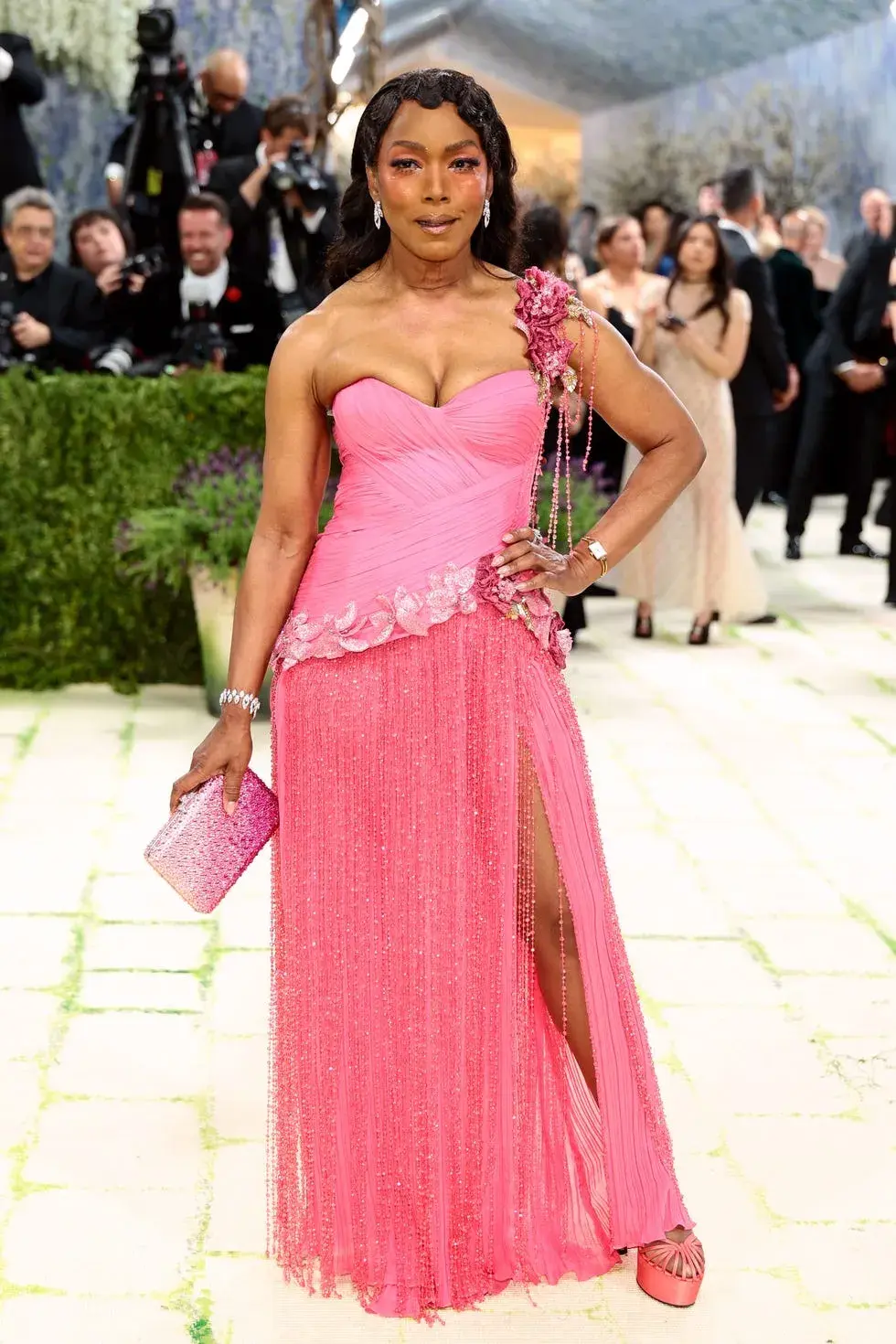
Angela Bassett - Prabal Gurung Gown - Reference: Girl in Pink Dress by Laura Wheeler Waring (1927).
Angela Bassett’s dress references a 1927 painting by Laura Wheeler Waring, a Harlem Renaissance artist whose work has been significantly underrecognised relative to her male contemporaries. Waring was a painter, illustrator, and educator who documented Black American life and identity in the early twentieth century.
Girl in Pink Dress is a portrait of a young Black woman in a pink dress, and Bassett desribed the reference on the carpet as being about “stepping into your power” which is an accurate reading of what Waring’s work does. Waring’s work is held by the Smithsonian American Art Museum, The Metropolitan Museum of Art, and various other collections, but is not as widely known as it should be.

Laura Wheeler Waring, Girl in Pink Dress (1927), Metropolitan Museum of Art, New York.

Lauren Sánchez Bezos - Schiaparelli gown - Reference: Portrait of Madame X by John Singer Sargent (1884).
The Schiaparelli gown work by Lauren Sánchez Bezos was a clear reference to John Singer Sargent’s most notorious painting. Madame X was shown at the Paris Salon of 1884 and caused a significant scandal. The subject, Louisiana-born socialite Virginie Amélie Avegno Gautreau, was depicted with a jewelled strap fallen from her shoulder, suggesting a degree of deshabille that Parisian society found intolerable. After the exhibition, Sargent repainted the strap in its upright position, and the painting was not publicly exhibited again until after Gautreau’s death. Madame X is now considered one of Sargent’s masterpieces and one of the defining paintings of the period. It’s currently in the collection of the Metropolitan Museum of Art.
The Schiaparelli dress captures the silhouette and the bare-shouldered drama of Sargent’s painting and, crucially, includes the fallen strap. Pearl and crystal straps were worn one on, one off-shoulder, matching the detail that caused the original scandal in the 1884 exhibition and led Sargent to repaint it in the upright position it’s in today. The choice of outfit by Sánchez Bezos is either deeply ironic, or entirely self aware, given that the event was surrounded by protest about the influence of her husband’s wealth, and that the original painting was of a woman whose social ambition made her a target of ridicule.

John Singer Sargent, Portrait of Madame X (1884), Metropolitan Museum of Art, New York.
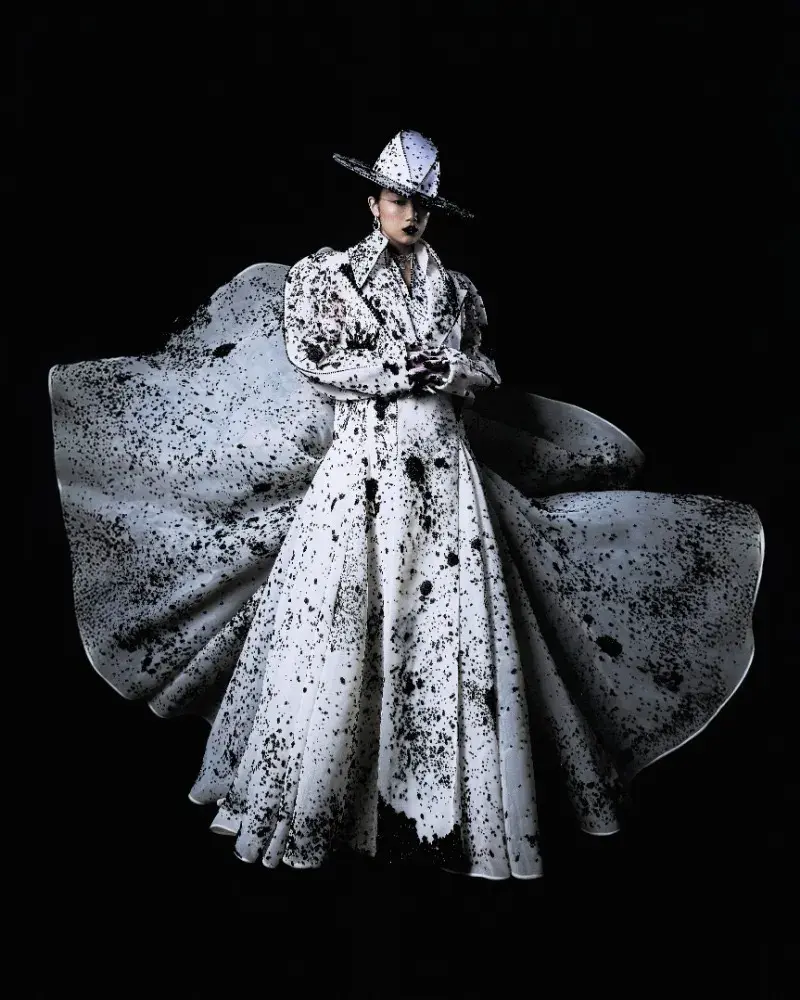
Audrey Nuna - Robert Wun Coat Dress - Reference: Number 26A by Jackson Pollock (1948).
Audrey Nuna’s Robert Wun coat dress, with paint splattered across the fabric, was a reference to Pollock’s drip paintings, specifically Number 26A, one of the major works from the period in 1947-50 when Pollock developed and refined his signature method of placing canvas on the floor and dripping, pouring, and flinging paint across it from above.
The variables of Pollock’s paintings, arm movement, paint viscosity, speed and distance from the canvas, were all controlled with a great deal of precision. The apparent chaos of the surface is the result of a sustained, physical, highly technical process. What is being cited when you reference Pollock in a paint-splattered dress is the look of the result without the process that produced it, which is a legitimate fashion approach.
Wun’s execution was strong, the splatters feel intentional rather than decorative, and the silhouette of the coat dress gives the paint marks a structure that the original canvas paintings deliberately resist. It gives us an interesting tension between the reference and the form which was done really well.

Jackson Pollock, Number 26A (1948), Musée National d’Art Moderne, Centre Pompidou, Paris.

Colman Domingo - Valentino Look - Reference: Composition with Red, Blue, and Yellow (1930).
Domingo’s outfit, with multicoloured geometric panels, and red sequin accents, was a reference to Mondrian’s primary colour grid paintings, the series of works he developed through the 1920s and 1930s in which black horizontal and vertical lines divide a white ground into rectangles filled with red, blue, and yellow. The paintings are some of the most reproduced in design history, having been applied to everything from Yves Saint Laurent’s 1965 Mondrian dress, to endless pieces of graphic design and packaging.
Mondrian’s grid paintings are a systematic attempt to reduce visual experience to its most fundamental elements: the vertical and horizontal, the three primary colours, and white. They come from a philosophical tradition, the Dutch De Stijl movement, that believed abstract visual harmony could reflect and even produce spiritual and social harmony. This context is absent from many citations of Mondrian, including this Valentino look, which used the geometric panel structure as a textile pattern without engaging the underlying point.
The execution, however, was confident, and the tailoring gives the look a sculptural quality that the flat grid of the original paintings doesn’t have, demonstrating visual intelligence, even where the conceptual engagement was limited.

Piet Mondrian, Composition with Red, Blue, and Yellow (1930), Kunsthaus Zürich.

Alexa Chung - JW Anderson at Dior Gown - Reference: Water Lilies series by Claude Monet (1897-1926)
Alexa Chung’s gown was a direct homage to Monet’s Water Lilies, the extended series of large-scale paintings he made of the pond in his Giverny garden from 1897 until his death in 1926. The series includes roughly 250 paintings and constitutes one of the most sustained meditations on a single subject in the history of art.
Monet began the series partially sighted from cataracts and completed many of the later works almost blind, which is evident in some of the most abstract panels. The large-scale installations at the Orangerie in Paris, where eight paintings are arranged in two oval rooms so that the viewer is surrounded by water and light, are among the most immersive experiences in any gallery in the world.
The Chung reference was green rather than the blue-violet palette that is most associated with the Water Lilies, but the reference is clear and works for the purpose of the gala, even if it’s not an accurate one.
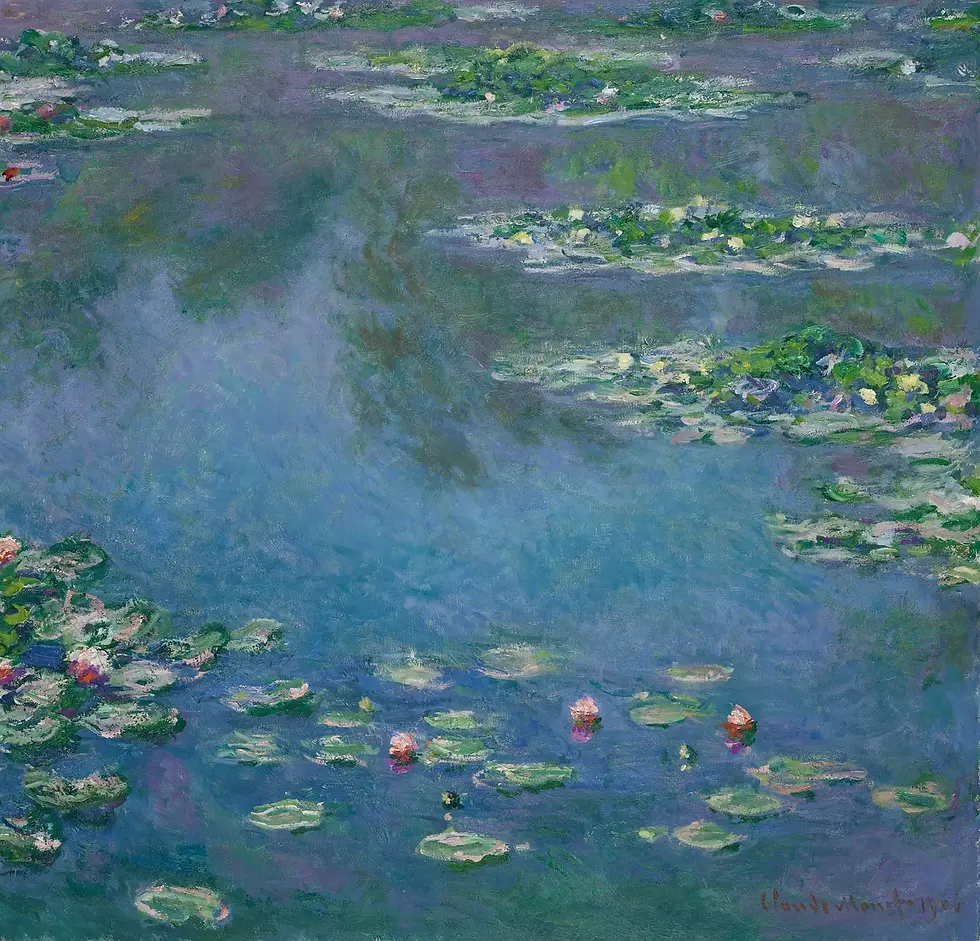
Claude Monet, Water Lilies (1906), Art Institute of Chicago.
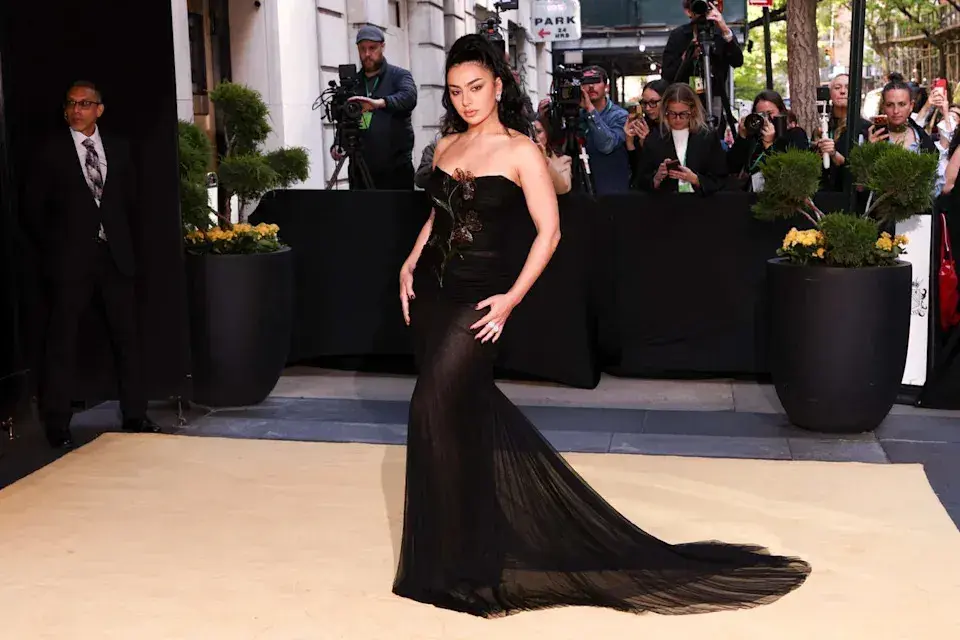
Charli XCX - Saint Laurent Gown - Reference: Irises by Vincent van Gogh (1889).
The Saint Laurent gown worn by Charli XCX references Van Gogh’s Irises, painted in May 1889 at the Saint-Paul-de-Mausole asylum in Saint-Rémy-de-Provence, shortly after Van Gogh admitted himself following his breakdown in December 1888. It is one of the most technically accomplished works of the last year of his life.
The painting is not the suffering Van Gogh of popular mythology. It’s a careful, almost cheerful piece of observation. It is currently at the J. Paul Getty Museum in Los Angeles, having been sold at Sotheby’s in 1987 for $53.9 million, a record at the time.

Vincent van Gogh, Irises (1889), J. Paul Getty Museum, Los Angeles.

Lena Dunham - Valentino gown - Reference: Judith Slaying Holofernes by Artemisia Gentileschi (1620).
Lena Dunham’s red gown with paint-like splashes across it was a reference to one of the most significant, and visceral, paintings in the history of Western art. Gentileschi’s Judith Slaying Holofernes depicts the biblical story of Judith, a Jewish widow who seduced and beheaded Assyrian general Holofernes to save her people. Gentileschi painted the subject multiple times, and the version at the Uffizi in Florence c.1620 is the most famous, portraying two women engaged in an act of considerable physical effort and determination, with blood spraying from the neck of the general.
Gentileschi was herself the survivor of a sexual assault by the painter Agostino Tassi, for which Tassi was tried and briefly imprisoned. The painting has been extensively read as an expression of the rage that this experience produced. It’s an extraordinary painting by an artist who was for centuries largely written out of the canon in the favour of her male contemporaries.
Translating that image into a red gown is an act of compression. What is retained is the colour, the blood, especially around the neck, and the implication of female power and violence. What is lost is everything that makes the painting so extraordinary, the quality of the rendering and the biographical weight behind it. As a fashion reference it works, but as an engagement with the painting, it oversimplifies it more than it deserves.

Artemisia Gentileschi, Judith Slaying Holofernes (c.1620), Uffizi Gallery, Florence.

Gracie Abrams - Chanel Gown - Reference: Portrait of Adele Bloch-Bauer I by Gustav Klimt (1907).
A second Klimt reference, alongside Schafer’s Mäda Primavesi, Abrams’ Chanel gown referenced Klimt’s most famous painting, commissioned by Viennese sugar magnate Ferdinand Bloch-Bauer as a portrait of his wife Adele. The painting is sometimes called The Austrian Mona Lisa and is one of the most valuable paintings in the world, having sold in 2006 for $135 million to the Neue Galerie in New York after a lengthy legal dispute over its restitution from Austria, where it had been seized by the Nazis in 1938.
The history of the painting is considerably heavier than its appearance suggests, with its all gold surface and decorative intensity. Adele’s face and hands emerge from a pattern that almost dissolves her into abstraction. What was referenced in Abram’s outfit was the golden register, the density of ornament, and the formal intensity of Klimt’s golden phase without engaging with any of the historical weight behind the object. As references go, it was technically accurate but contextually thin.
Two Klimt references in one evening is perhaps one too many. Schafer’s Mäda Primavesi did more with the reference than Abrams’ Adele, partly because Prada found something to add to it, and partly because Adele is so thoroughly iconic that any citation risks becoming decoration.

Gustav Klimt, Portrait of Adele Bloch-Bauer I (1907), Neue Galerie, New York.

Emma Chamberlain - Mugler Gown - Reference: Vincent van Gogh
Emma Chamberlain wore a Mugler dress by Miguel Castro Freitas, and hand-painted by Anna Deller-Yee. It was described variously by different sources as referencing Van Gogh’s Enclosed Field with Ploughman, The Starry Night, and general Van Gogh and Munch. Chamberlain herself described the dress as having a “watercolour feel” with “a creepy, ominous undertone.”
The specific reference remains unconfirmed, but what is clear from the photographs is that it’s a hand-painted design drawing on Post-Impressionist painting techniques without being pinned to a specific work. The execution was by many accounts the most technically extraordinary outfit of the evening. Four people helped carry it up the stairs. The vague reference could be considered to both undermine or add to its interest, as it’s more an atmospheric gesture than a rigorous citation.

Vincent van Gogh, Enclosed Field with Ploughman (1889), Museum of Fine Arts, Boston.
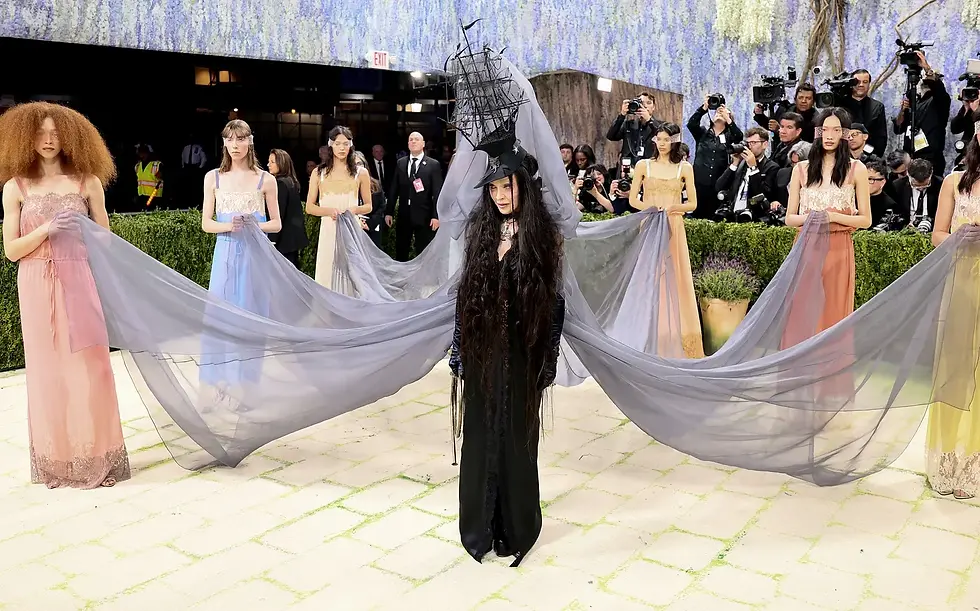
Madonna - Saint Laurent dress and cape - Reference: The Temptation of St. Anthony by Leonora Carrington (1947).
Madonna arrived in a Saint Laurent dress and cape, wearing a ship headpiece and accompanied by seven attendants. This is a reference to Leonora Carrington’s 1947 oil painting. Carrington was a British-born, Mexico-based Surrealist whose work combined mythology, folklore, alchemy, and the female perspective in ways that were consistently overlooked in favour of her male contemporaries.
The Temptation of St. Anthony depicts a fantastical scene of a saint surrounded by strange creatures, rendered in Carrington’s characteristic style of precise, jewel-like detail applied to impossible subjects. It’s a painting about temptation, transformation, and the permeability of the boundary between the human and the other.
What the Saint Laurent look captured was the theatrical darkness of Carrington’s imagery without the specific content of the painting. It was appropriately surrealist: the logic of the dress is dream logic rather than direct quotation, confusion that Carrington probably would have approved of.

Leonora Carrington, The Temptation of St. Anthony (1947), Private Collection.

Kendall Jenner - Gap Studio Gown - Reference: The Winged Victory of Samothrace (c.190 BCE)

Yu-Chi Lyra Kuo - Jean Paul Gaultier Gown - Reference: Winged Victory of Samothrace (c.190 BCE)
Two looks on the night referenced the Winged Victory. Kendall Jenner wore Gap Studio by Zac Posen with painted wings on the train, and Yu-Chi Lyra Kuo wore a Jean Paul Gaultier white winged gown. The Winged Victory of Samothrace is a marble sculpture of the goddess Nike, discovered on the Greek island of Samothrace in 1863. It now sits at the top of the Daru staircase in the Louvre, having presided over the entrance of the Greek antiquities collection ever since.
The sculpture is headless and has no arms, making what it does have, its wings, even more of a feature. The large, swept back, marble wings were carved with extraordinary technical skill and a sense of forward movement so convincing that the figure appears to still be landing on the ship that forms its base. It’s one of the most powerful sculptures in Western tradition, in part due to its incompleteness.
Jenner’s reference used the wings painted onto the train of the dress, while Kuo’s Gaultier used the swept back wing structure as a silhouette. Both captured the drama of the sculpture’s defining feature and as references to ancient sculpture go, both were straightforward and well-executed.

Unknown Artist, Winged Victory of Samothrace (c.190 BCE), Musée du Louvre, Paris.
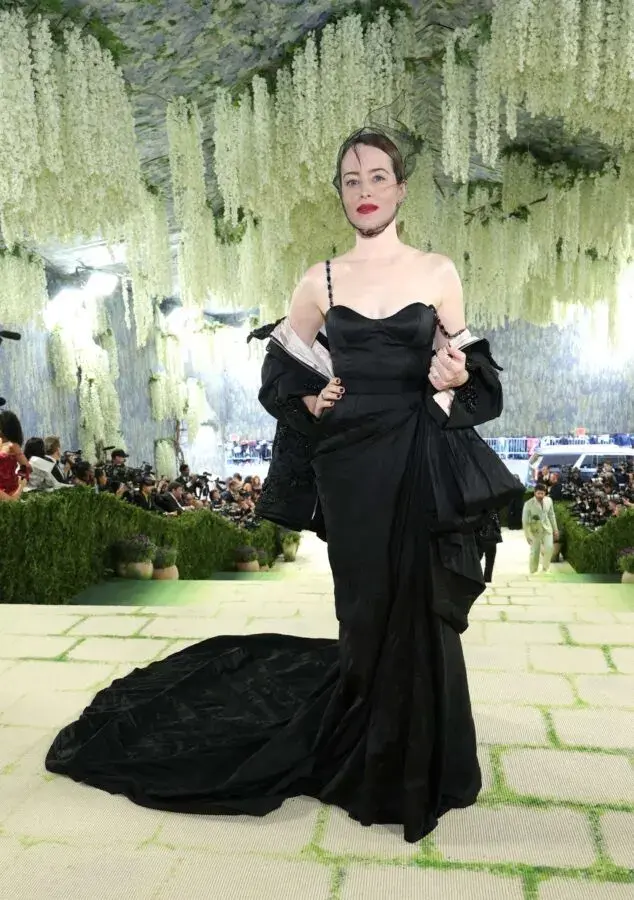
Claire Foy - Erdem and Barbour Gown - Reference: Portrait of Madame X by John Singer Sargent (1884).
Three looks on the night referenced the same Sargent portrait. We’ve already covered Sánchez Bezos in Schiaparelli, but it is also worth mentioning Foy’s Erdem and Barbour Gown. The three attendees independently cited this same painting which could be a coincidence, or evidence of a trend which circulated in the lead up to the event.
Foy’s version was probably the most considered of the three, with the Erdem corset construction giving the silhouette a structural quality that engaged with the painting’s composure. The Barbour collaboration was unexpected, but the look works well.

John Singer Sargent, Portrait of Madame X (1884), Metropolitan Museum of Art, New York.

Lisa Airan - Christoper Kane Gown - Reference: La Danse I (1909) by Henri Matisse
Airan’s Christopher Kane FW15 gown references Matisse’s La Danse. The painting is of five nude figures dancing in a circle against a simple background of blue and green. Matisse painted two versions: the first La Danse I (1909) has been at MoMA in New York since 1963, and the second La Danse II (1910) is at the Hermitage in St Petersburg. Both were commissioned by the Russian collector Sergei Shchukin who intended the final version to hang on the staircase landing of his Moscow palace.
The painting is one of the defining works of early modernism, the figures are barely described, the colour is unmodulated, and the composition is entirely flat. It has almost no depth, yet is full of energy, rhythm, and movement. The Christopher Kane gown captures the circular arrangement of figures and the warmth of the colour palette without the primitivism that characterises Matisse’s handling of the body.

Henri Matisse, La Danse I (1909), Museum of Modern Art, New York.
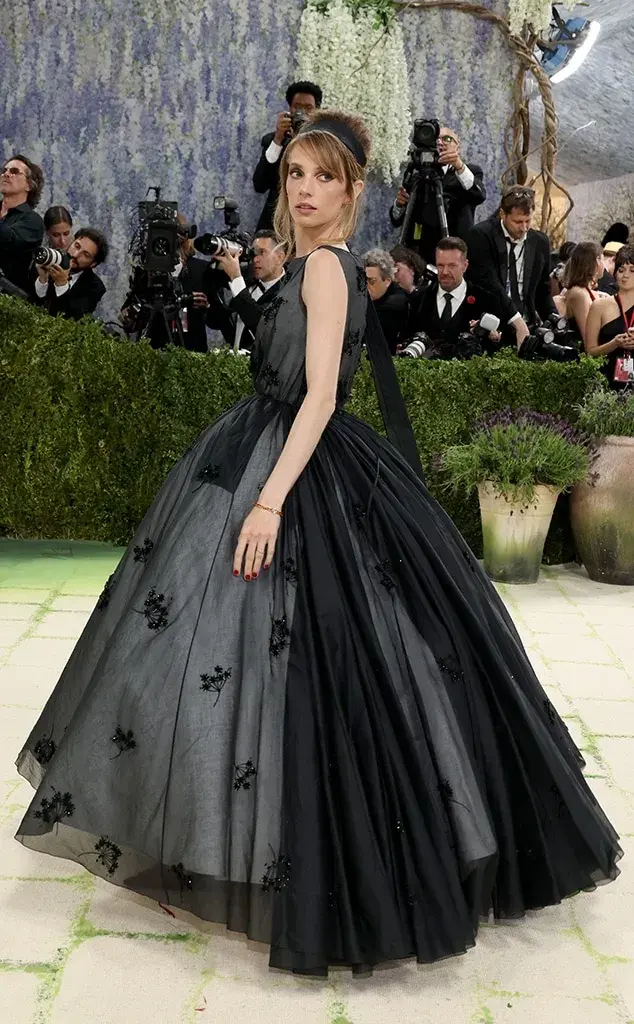
Maya Hawke - Prada Gown - Reference: The Swing by Jean-Honoré Fragonard (1767).
Hawke’s look was one of the vaguest references of the night: a custom Prada dress, black over a white double satin base, scattered with delicate floral micro-embroidery. Described as loosely inspired by the Rococo painter Jean-Honoré Fragonard, best known for The Swing (1767). The reference is to the floral density and eighteenth-century romantic sensibility of Fragonard’s work. The pinks, greens, and dappled gold light of his colour palette didn’t survive the transition, but the embroidered detail and voluminous silhouette did. Both of these factors carry the period quality that justifies the reference without committing to any specific work. The “loose” qualifier in the description of this look did significant work.
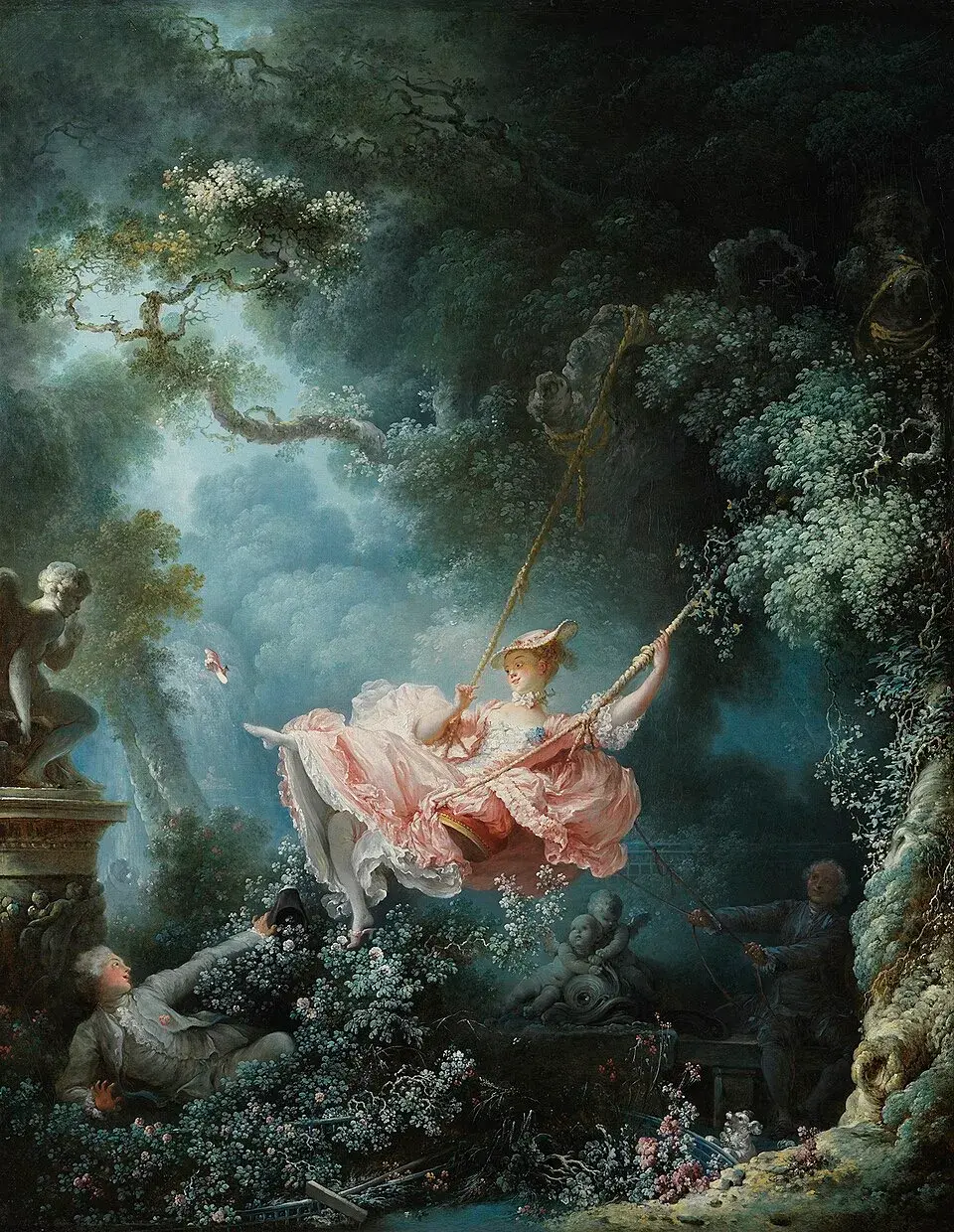
Jean-Honoré Fragonard, The Swing (1767), Wallace Collection, London.
What the Evening Revealed
The theme Fashion is Art is broad enough to accommodate almost everything that appeared on the carpet this year, which is part of the problem. The evening highlighted the difference between knowing what you’re referencing, and knowing why you’re referencing it.
The looks that held up were the ones that earned their references. Schafer’s Klimt found something to add, Platt’s Seurat translated technique into a different medium, and Kardashian’s Jones look raised some interesting questions. Sherald wore her own work, and the choices of underrecognised artists like Pruitt, Waring, and Opiangah, were some of the most considered.
Three people wore outfits referencing the same Sargent. The painting is about a woman whose social ambition made her a spectacle, something that translates well to such an event.
The most discussed question of the night was not which look referenced which artwork, but whether the event should have been co-chaired by Jeff Bezos, given the conditions under which Amazon workers labour and the gap between the money in the room and the public mission of the museum. Those who declined to attend the event perhaps made the strongest argument of the night.
Further Reading
On Portrait of Madame X: Sargent’s own account of the painting’s reception, quoted in Trevor Fairbrother’s John Singer Sargent (Abrams, 1994). The Metropolitan Museum of Art’s collection record at metmuseum.org is also thorough.
On Judith Slaying Holofernes: Mary Garrard’s Artemisia Gentileschi: The Image of the Female Hero in Italian Baroque Art (Princeton, 1989) is the defining scholarly account. For something shorter, Jonathan Jones’ writing on Gentileschi for the Guardian is accessible and well-informed.
On Allen Jones: The catalogue for the retrospective at The Royal Academy of Arts, London (2014-15) covers the controversy and the work in depth.
On A Sunday on La Grande Jatte: The Art Institute of Chicago’s own catalogue entry at artic.edu is extensive and excellent.
On Irises: the J. Paul Getty Museum’s collection record at getty.edu covers the provenance, including the 1987 auction sale.
On the Costume Institute and the Met Gala: Andrew Bolton, curator of the Costume Institute, has given several interviews about the Costume Art exhibition that are worth reading alongside the red carper coverage. The Met’s own documentation at metmuseum.org covers the exhibition programme.
Closing Note
The Met Gala happens once a year and is immediately, comprehensively over-documented. By the time this article goes out on Wednesday, most of the looks will have already been ranked, scored, and filed away. What lasts longer is the question the evening raises, whether fashion, an industry that is commercial, seasonal, worn by bodies that age, produced under supply chains that are rarely examined, can, like art, mean something beyond the moment of its making.
Thoughts, corrections, or a Met Gala look we should have included: reply to this email. I read everything.


Comments