Ideals vs Reality: Craft, Labour, and the Domestic Interior
Red House
Red House in Bexleyheath sits low behind an orchard. It was completed in 1860, designed by architect Philip Webb. With plain red brick, a steeply pitched roof, and no applied ornament anywhere on the exterior, it looks unlike anything else that was being built in England at the time. The domestic architecture of Victorian England was typically concerned with surface: stucco, mouldings, and decorative details that signalled the wealth of the owner. Red House has none of this. The brick is left exposed, the windows are placed where rooms need light rather than considering external symmetry, and the Gothic arches are structural instead of decorative. Inside, the rooms are organised around use rather than display, with the fire as the focal point, encouraging conversation and family living.

Red House, Bexleyheath, Kent, 1859–60. Philip Webb, architect | © National Trust Images / Andrew Butler
Red House is a set of design principles made physical. Dante Gabriel Rossetti, who visited many times after the house was completed, called it “more of a poem than a house”, which is one way of describing a building whose every decision is an argument. The argument was that of William Morris, who commissioned the house and co-designed it with Webb, who he’d met at G.E. Street’s office, where they had both worked. When he commissioned the house, Morris was twenty-five, newly married, and independently wealthy after inheriting shares in a Devon copper mine from his father. He had spent his years at Oxford reading John Ruskin’s essays on the moral degradation of factory work, and Red House was his attempt to build the alternative. Morris’ wife Jane was a gifted embroiderer, and their wall hangings were made for specific rooms in the house. The stained glass was designed by his close friend Burne-Jones, and their furniture was hand-painted with Arthurian scenes by Morris himself and his friends. Everything in the house had been made by someone whose intelligence was engaged in the making.
It is one of the most influential domestic buildings of the nineteenth century, and it was funded exactly by the kind of inherited industrial wealth that he would go on to spend his life arguing against. The gap between the design principles Red House embodied, and the economic reality of who could commission and afford such a house, is the central tension of the Arts and Crafts movement, and it was never resolved.

Red House, drawing room interior, c.1860 | © National Trust Images / Andreas von Einsiedel
Useful Work
The Arts and Crafts movement made a specific argument: that industrial manufacturing was degrading both the objects it produced and the people producing them, and that the antidote was work done by hand, by people whose intelligence was engaged in the making. The argument generated some of the most carefully designed domestic interiors in the history of British architecture.
It also generated a design culture that was realistically available only to the wealthy, and that was funded by the industrial profits it claimed to oppose. The situation now is still nearly identical. The vocabulary of Arts and Crafts, handmade and slow, is everywhere in contemporary design, and the people who are buying, for example, expensive hand-thrown ceramic mugs, are not, as a general rule, the people making them. Morris said in 1883 that he was spending his life “ministering to the swinish luxury of the rich.” He never resolved this feeling, and it’s one that many of us in the creative industries recognise today.

Wightwick Manor, Wolverhampton, West Midlands, 1887. Morris & Co. textiles and decoration | © National Trust Images / Andreas von Einsiedel
The industrialisation of British manufacturing from around the 1830s onward made it possible to stamp out decorative details quickly with factory production, and that’s exactly what manufacturers did. Objects began to be covered in applied ornament that had no structure or material logic, an issue which was made highly visible at the Great Exhibition of 1851 at the Crystal Palace, an event that more than six million people attended. It had been intended as a celebration of British industrial output, but many critics viewed it more as a demonstration of how badly machine production could degrade an object.
John Ruskin made the most articulate diagnosis in The Nature of Gothic, published as part of The Stones of Venice in 1853. He argued that factory production not only produced ugly objects, but degraded the people making them by removing the element of judgement from their work. The medieval craftsman, he said, was someone whose intelligence was engaged by what he made, whereas the factory operative who stamped out identical ornaments was not. This was a moral problem as well as an aesthetic one, and Ruskin stated this clearly enough that his essay remained influential for decades.
Morris read Ruskin whilst studying at Oxford, and it shaped the rest of his life. He later referred to The Nature of Gothic as “one of the very few necessary and inevitable utterances of the century,” and, in 1892, printed it on his own Kelmscott Press as a standalone volume. Morris pushed Ruskin’s argument further, making it explicitly political. He believed that industrial capitalism hadn’t just produced bad ornament, but that it had severed the relationship between work and pleasure entirely, and in his 1884 pamphlet Useful Work versus Useless Toil, he wrote that “nothing should be made by man’s labour which is not worth making, or which must be made by labour degrading to the makers.”
The difficulty of furnishing Red House led directly to the founding of Morris, Marshall, Faulkner & Co. in 1861, by Morris with Ford Madox Brown, Edward Burne-Jones, Charles Faulkner, Dante Gabriel Rossetti, P. P. Marshall, and Philip Webb. The firm made wallpapers, fabrics, furniture, stained glass, and tiles, all designed by Morris and his circle and made by hand where possible. It was reorganised as Morris & Co. in 1875 with Morris as sole proprietor and ran until 1940.

“Strawberry Thief” furnishing fabric, William Morris for Morris & Co., 1883. Indigo-discharged and block-printed cotton | © Victoria and Albert Museum, London
Morris, Marshall, Faulkner & Co.’s early output looked fairly different from what most people picture when they think of Arts and Crafts. The furniture was heavy and painted, decorated with scenes from Arthurian legend like that at Red House. The Sussex chair, a simple turned-wood armchair with a rush seat that the firm adapted from a traditional design found in Sussex, became one of their most popular and widely copied pieces. It’s one of the clearest early examples of an interest in vernacular craft over invented medievalism. In 1866, the company received its most significant early commission, the redecoration of the Armoury and Tapestry Room at St James’s Palace, which is still largely intact. By the 1870s, as Morris increasingly focused on textiles and developing natural dyes, the firm’s outputs shifted toward the wallpapers and fabrics that would define its legacy.
Morris & Co. found its market, but it was an upper-middle-class one. The wallpapers required large Victorian rooms to show well, and the textiles, dyed with natural pigments like indigo, madder, and weld, cost significantly more than their machine-dyed equivalents because the process was slower and the materials were more expensive. The people who could afford to buy them were not the same factory workers whose conditions Morris would go on to spend his political life trying to improve.
The Guilds
Through the 1870s and 1880s, the movement spread beyond Morris’ own firm. Guilds formed in conscious opposition to industrial production: the Century Guild (1882), the Art Workers’ Guild (1884), and C.R. Ashbee’s Guild of Handicraft (1888). Ashbee’s Guild was the most ambitious, combining a workshop with a communal living arrangement. In 1902, it relocated from London’s East End to the Cotswolds, attempting to live as well as work according to Arts and Crafts principles. Around 150 craftspeople and their families made the move, but just six years later they went into voluntary liquidation. The rural setting had made it difficult to attract clients, and the economics didn’t work.
The Century Guild, founded by Arthur Heygate Mackmurdo and the designer Selwyn Image, was the first of the Arts and Crafts guilds, predating Ashbee’s by six years. Mackmurdo had a different approach to Morris, looking away from medievalism and instead producing sinuous, organic patterns, prefiguring Art Nouveau by a decade. The Guild’s journal, called The Hobby Horse, launched in 1884 and was the first of the Arts and Crafts periodicals. It showed the movement’s range from the outset, highlighting that it was a set of shared principles rather than an aesthetic direction, which meant that it could produce very different visual results.
In America, Gustav Stickley produced Craftsman furniture and published The Craftsman magazine from 1901 to 1916, making Arts and Crafts ideas available at lower price points and to a broader audience. In Austria, Arts and Crafts fed into the Vienna Secession and the later Wiener Werkstätte. In Sweden, Carl Larsson’s illustrated books of his family home at Sundborn, starting with Ett Hem in 1899, carried Arts and Crafts sensibilities across Europe and influenced what became Scandinavian modernism.
Ernest Gimson came closer than anyone to living the movement’s ideals without contradiction. He trained in London under Lethaby and moved to the Cotswolds in the early 1890s with architects Sidney and Ernest Barnsley. He spent the rest of his life making furniture and architectural plasterwork of exceptional quality in a converted house in Sapperton, Gloucestershire, working with local craftspeople, keeping his prices lower than the London market would have allowed, and refusing commissions that would require him to compromise his making process. His work was restrained, technically demanding, and rooted in English vernacular traditions rather than medieval fantasy. It was probably the most convincing resolution the movement found to the gap between Morris’ politics and his practice. The Cheltenham Art Gallery holds the largest collection of his furniture and drawings.

Drawing Room, Standen House, West Sussex, 1892–94. Philip Webb, architect. Morris & Co. soft furnishings | © National Trust Images / James Dobson
The Focus of the Home
Red House isn’t alone in feeling immediately different from most Victorian interiors. Go to Standen in East Sussex, or Blackwell in Cumbria, and you will notice this too. They feel thought about, with more living space, and less stuff on display. The principles that produced this were deliberate design positions: each one derived from a specific argument about what a room should be and do.
The most fundamental was materials. Timber usually wasn’t plastered over, and stone floors would be left uncarpeted. The principle came directly from Ruskin’s “Lamp of Truth” in The Seven Lamps of Architecture (1849), that structural and material logic should be visible in a building. C.F.A. Voysey, active from the late 1880s through the 1900s, pushed this principle further than Morris had, preferring plain whitewashed plaster walls to pattern. His houses are lighter and calmer than Morris’ medievalism, and what makes them still feel good is partly that restraint. Voysey worked at the scale of the whole building, and inside, he designed everything including curtain fabrics, wallpaper, carpets, metalwork, and furniture. He used a heart motif across his decorative metalwork and furniture details, not as applied ornament in the Victorian sense, but as a kind of signature embedded in functional elements. His furniture was produced initially by F. Coote, and tended to be plain, slightly oversized, and with visible joinery. Broad Leys in Windermere, Cumbria (1898), and The Orchard in Chorleywood (1899), are among the best examples of his work, showing what he could do with a limited palette.

The Orchard, Chorleywood, Hertfordshire, 1899. C.F.A. Voysey, architect | © RIBA Collections
The fireplace was central to Arts and Crafts domestic thinking. In Houses and Gardens(1906), his main theoretical statement, Baillie Scott called the fire “the focus of the home”, around which the living spaces should be designed. Inglenook fireplaces wide enough to sit inside appear throughout his and Voysey’s domestic work, because a room organised around warmth and gathering was, in their view, fundamentally different in character from the standard Victorian drawing room which was organised around display.
Fireplace surrounds were also designed objects. William De Morgan, who worked closely with Morris & Co. from the late 1860s onwards, produced tiles that were features in fireplaces, bathrooms, and entrance halls across hundreds of Arts and Crafts houses. His use of glazes and Islamic-influenced patterns of fish, birds, and foliage, produced some of the more distinctive objects of the Arts and Crafts movement. The most dramatic example of his work in situ is the Arab Hall at Leighton House (1877-79) in London, which incorporated his tiles alongside authentic Islamic tilework. It’s a common misconception that ornament was rejected in Arts and Crafts, but in reality the movement believed it was important, but that it should come from a real tradition of making rather than being stamped from a mould in a factory.
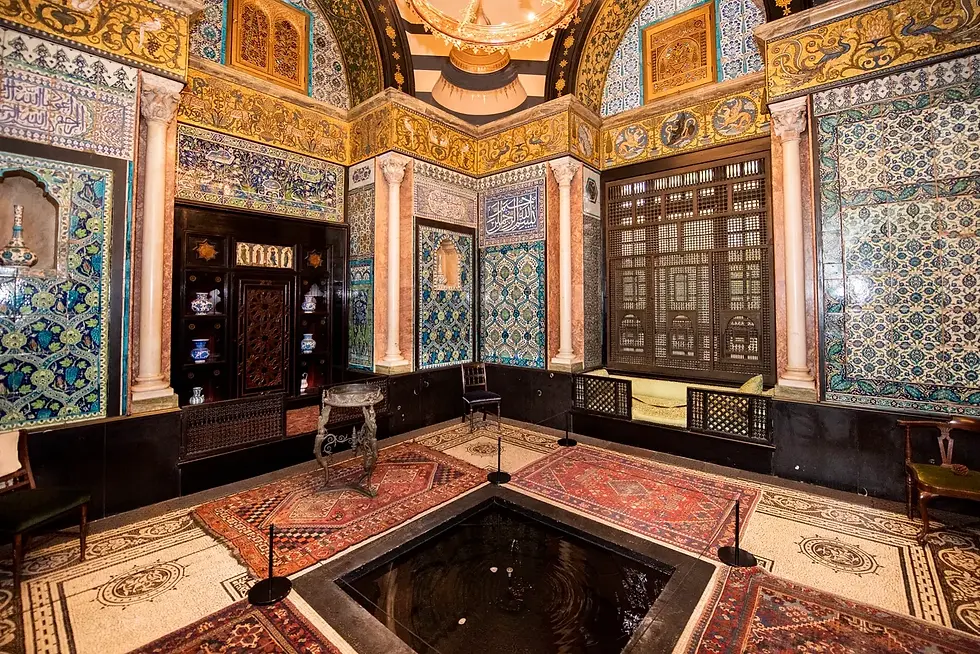
The Arab Hall, Leighton House Museum, London, 1877–81. Architect George Aitchison; tiles assembled by William De Morgan | © The Royal Borough of Kensington and Chelsea.
With honest materials providing the structure, and the fire providing the centre, the furniture could now be integrated rather than imported. Baillie Scott argued in Houses and Gardens that furniture should form “a part of the architecture of the house, and not a collection of separate objects.” When it works, the effect is that a room feels entirely considered, but it risks inflexibility and limits options for later changes in a space.

The Great Hall, Blackwell, Windermere, Cumbria, 1900. M.H. Baillie Scott, architect | © Lakeland Arts
Morris’ wallpapers and textiles were based on natural forms, primarily botanical. They combined a meticulous, stylised, observation of nature with structured, rhythmic, and layered repeat patterns. He spent years studying medieval tapestry and botanical illustration, and his patterns reward close attention. He researched and selected his natural dyes because he thought the more commonly used aniline dyes, introduced from the 1850s, were visually inferior. Over time the colour deepens and takes on a warmth and depth that synthetic dyes can’t replicate, and an original Morris & Co. interior still in its original textiles looks genuinely different from a reproduction.

“Acanthus” wallpaper, William Morris for Morris & Co., 1875. Block-printed in distemper colours on paper | © Victoria and Albert Museum, London
The Arts and Crafts palette was a considered position in itself, not just a byproduct of natural dyes. Made up of the ochres, madder reds and indigo blues of Morris’ wallpapers, the warm whites of Voysey’s plaster, and the deep greens of De Morgan’s glazes, the colours were chosen partly because they came from the earth and aged with it, and partly because they were a contrast against the palette that cheap aniline dyes had introduced to Victorian manufacturing. Together, they produced interiors with a specific chromatic character: warm, muted, and capable of being lit by candle and firelight without washing out.
These interiors are dark by contemporary standards, with high wainscoting, and sometimes quite narrow windows. This was partly ideological, the house turned against the industrial city outside, and partly a practical consequence of designing with the fire in mind rather than natural light.
Standen and Blackwell are some of the best surviving examples of Arts and Crafts interiors, as well as, of course, Red House.
Swinish Luxury
The design principles were coherent, but in practice they created problems as well as solving them. The darkness that made an Arts and Crafts interior feel sheltered and inward could also make it feel oppressive. The integration of furniture and architecture that produced rooms of extraordinary resolution could leave inhabitants unable to adapt a space to changing lives. By the early twentieth century, the Gothic furniture and Arthurian imagery that had been central to the movement’s early vision looked dated in a way that Voysey’s whitewashed restraint did not, and when modernism arrived, that historicism was exactly what it was pushing back against.
William Morris was a committed socialist. He joined the Marxist-influenced Social Democratic Federation in 1883, but left it as he believed parliamentary politics to be inadequate. He then helped found the Socialist League. He gave lectures with titles like Art Under Plutocracy and understood the contradiction in his own commercial position. E.P. Thompson’s William Morris: Romantic to Revolutionary, first published in 1955, and still the most serious account of his politics, argues that Morris eventually concluded that aesthetic transformation wasn’t possible without social revolution first, effectively admitting that his business wasn’t going to change anything.
Ashbee’s Guild of Handicraft made the most determined attempt to actually solve the problem. Founded in Whitechapel in 1888, it was built around a genuine community of craftspeople rather than a commercial firm employing them. The guild members owned shares, shared profits, and were intended to have a stake in what they made and sold. Ashbee was also more honest than most of his contemporaries about the political implications of the movement’s position. When the Guild went into voluntary liquidation in 1908, six years after relocating to the Cotswolds, Ashbee wrote about it directly in Craftsmanship in Competitive Industry (1908). He concluded that craft could not survive within capitalism without subsidy or patronage, which is a harder admission than anything Morris put in writing. The Guild’s failure didn’t invalidate the movement, but highlighted what it was actually up against.
When Ernest Gimson died in 1919, he had never achieved financial stability. Like Ashbee’s guild, his story seems to suggest the movement’s principles were not economically viable outside a patron relationship.
The movement’s relationship to women’s labour is also worth examining. Morris & Co. employed significant numbers of women for embroidery. They framed this as a revival of a meaningful domestic craft, but really it was domestic labour reclassified as art, so that they could sell it at higher prices while paying the women piecework rates. Jane Morris and her daughter May were both skilled embroiderers, and May became the director of Morris & Co.’s embroidery department in 1885 aged twenty-three. She was a significant designer in her own right, and also edited her father’s twenty-four-volume Collected Works and co-founded the Women’s Guild of Arts in 1907. Despite this, she is significantly underrepresented in accounts of the movement. This is addressed in both Anthea Callen’s Angel in the Studio (1979) and Anna Mason’s May Morris: Art and Life (2017).
The medievalism in the movement is also worth looking at critically. Morris’ visions of the medieval period were largely fictional, a projection onto a period which was in reality defined by drudgery, disease, and rigid hierarchy. The guild craftsmen whom he romanticised had little to do with actual medieval labour, and the argument of the movement that handwork is more human than machine work, was based on this idealised history. T.J. Jackson Lears, in No Place of Grace (1981), identifies Arts and Crafts as part of a broader pattern of “antimodernism” in which the people who benefited the most financially from capitalism, fled the consequences of it aesthetically. This seems a fair description of the movement’s social position, and this contradiction isn’t resolved just because it produced some beautiful interiors.
Without the Medieval Costume
The Craftsman bungalows built across America between 1905 and 1930 are the most widely distributed expression of Arts and Crafts domestic ideas. They were modest houses with visible timber framing, front porches, and built-in furniture, and they remain among the most sought-after residential properties in the U.S. The architects Charles and Henry Greene, working in Pasadena, produced the most refined American examples; their Gamble House (1908) is a building of such considered detail that it’s genuinely difficult to find anything in it that hasn’t been thought about.
Frank Lloyd Wright’s early domestic work would also belong in this lineage, even though he would have resisted the association himself. His 1900s Prairie houses took the spatial principles of Arts and Crafts and stripped away the historicism that Morris and his circle depended on. They were integrated with their landscapes, with built-in furniture, and unified interior schemes. Where the Greenes looked back to Japanese craft traditions and English vernacular building, Wright was trying to produce something that he called authentically American. But his underlying arguments were that a building should grow from its site, that structural logic should be visible, and interior and exterior should be conceived together. These are the same arguments that Ruskin had made in 1849, and that Morris built his house around in 1859. Wright is the figure who takes the movement’s spatial ideas into the twentieth century without the medieval costume.
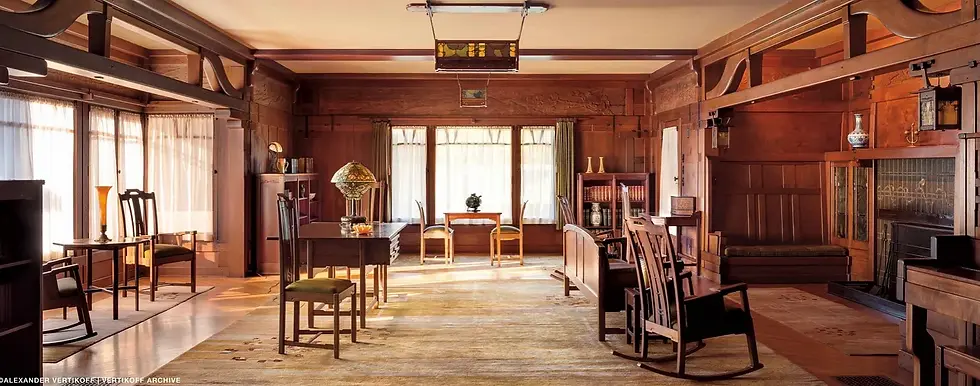
The Gamble House, Pasadena, California, 1908. Greene & Greene, architects. Living room interior | © Alexander Vertikoff / Gamble House
In Britain, Arts and Crafts filtered into the suburbs, and eventually became so deeply ingrained into the DNA of English domestic architecture that its principles became invisible. They no longer felt like a movement, and became just what a sensible house should look like.
The connection to Bauhaus is often under-acknowledged too, in part because the Bauhaus later downplayed it. Gropius’ 1919 founding manifesto explicitly invokes the medieval guild as the model for the school’s structure, and the early curriculum under Johannes Itten included ideas about the unity of art and craft. As the school moved toward machine production in the mid-1920s, it began to deprioritise this lineage.
The movement’s most significant institutional legacy in Britain is probably the Central School of Arts and Crafts, founded in London in 1896 with W.R. Lethaby as its first principal. Lethaby was the most intellectually serious figure in the movement after Morris, and his approach was different in a significant way: where Morris believed the solution was to make better things, Lethaby believed the solution was to produce better-educated makers and designers, at scale, through public education. The Central School taught craft alongside design and fine art without hierarchy between them, the same principle as Bauhaus a decade before it existed. Lethaby’s Architecture, Mysticism, and Myth (1891), influenced a generation of architects and designers, and his thinking about ornament, structure, and the relationship between building and making was more developed than Morris’. The Central School eventually became Central Saint Martins, and this lineage is not often acknowledged in accounts of the institution.
The more direct lineage is easier to trace in furniture and craft than in architecture. Edward Barnsley’s workshop in Hampshire, established in 1919 and still operating, runs in an almost unbroken line from the movement’s guild tradition; Barnsley’s father Sidney was a member of the Kenton & Co. collective that grew out of the Art Workers’ Guild in the 1890s. In contemporary British furniture making, makers like Matthew Burt and the remaining workshop-based makers in the Cotswolds region are working within the same tradition, whether or not they identify it as such. In interior design, Ilse Crawford’s approach to materiality, warmth, and the relationship between objects and the people who use them, draws on the same principles Morris was arguing for in 1880, translated into a contemporary register. In America, the Arts and Crafts influence on West Coast residential architecture has been continuous since the Greene brothers, with an emphasis on natural materials, integrated design, and buildings that respond to landscape rather than ignore it. These ideas can still be seen in design on the West Coast today.
Charles Rennie Mackintosh is worth noting too, because his work sits at the point where Arts and Crafts started to transform into early modernism. His domestic interiors, particularly Hill House in Helensburgh (1902–04), took the movement’s integrated design principle further than almost anyone, designing every element of a room as part of a single scheme. But the aesthetic was no longer historicist. The white rooms, the abstracted plant forms, and the attenuated furniture were Arts and Crafts principles, and Mackintosh is the figure who shows most clearly where the movement ended and early modernism began.

Main bedroom, Hill House, Helensburgh, 1902–04. Charles Rennie Mackintosh, architect; embroidered hangings designed by Margaret Macdonald Mackintosh | © National Trust for Scotland
Contemporary design culture is saturated with Arts and Crafts ideas, but almost entirely stripped of the political content that gave those ideas their original meaning. The aesthetic is still visible in handmade objects, natural materials, visible construction, and the references to ‘slow’ and ‘honest’, but the argument surrounding these principles didn’t survive in the same way.
Back to Bexleyheath
Red House demonstrates a set of design principles in 1860 that were tested and argued about by the Arts and Crafts movement for the next fifty years. It’s worth returning now to those principles and assessing which of them actually hold up.
The use of honest materials and the preference for visible structure over applied ornament is one of the things Arts and Crafts got right. Buildings with surfaces that show what they are made of and how they are put together tend to be easier to maintain and repair, and materials such as stone, brick, hardwood, and wool age well and feel different to those that might be considered more decorative. This principle passed through the Bauhaus, Scandinavian modernism, and other movements which value authenticity over effect, and it is still one of the most reliable tests as to whether an interior is actually well made or just well finished.
The principle that a room should be organised around warmth and gathering is still present, but a fireplace is not always considered the answer, especially in the specific Arts and Crafts form of a wide inglenook, usually in a room with narrow windows. This produced rooms that were deliberately dark, in a sort of refuge from the industrial world outside, without that context, the principle loses its logic. Nowadays, at least in Britain, windows tend to be bigger, most modern houses aren’t built with fireplaces at all, and rooms are quite often centred around something that didn’t even exist in Morris’ day: the television. The principle survives, the room needs a centre to organise furniture and attention around, but the fire is often no longer the answer.
Built-in furniture is a principle which still exists. Baillie Scott’s argument that furniture should be part of the architecture rather than a collection of separate objects, does produce beautiful results when everything is designed together from the start. The risk is inflexibility, and the contemporary equivalent is probably the fully-fitted kitchen, which is both the logical extension of this Arts and Crafts ideal, while also proving its faults: there is no room left for anything to be added or changed. The principle is a good one, but the application requires some restraint and a careful consideration of the future of the room and its users.
Scale is the principle most directly applicable to contemporary design, as well as the most consistently ignored. There is a tendency in contemporary interiors to underscale furniture, and to choose pieces which look considered in isolation but don’t necessarily feel right in the space, which is exactly what the movement argued against.
Natural pattern and colour are the areas where the movement’s influence has been most thoroughly absorbed and misrepresented. Morris’ botanical patterns were complex, slow to read, and rooted in decades of study. Contemporary design culture took from them the idea of organic pattern generally, which can now be found everywhere and in various levels of sophistication.
As well as this, the idea that colour should age and deepen with light rather than fade, is genuinely worth recovering. The majority of contemporary textiles degrade over time, while original Morris & Co. textiles in good condition have aged better than many reproductions.
The equation of handmade with meaningful is worth questioning, too. It’s a romantic position to take. Machine-made objects can be extraordinary, and handmade objects can be bad. What Morris was actually arguing in Useful Work versus Useless Toil was that what matters more are the conditions under which something was made and for whose benefit. It’s a lot more complex than just “buy handmade”.
One of Morris’ best-known quotes was: “Have nothing in your houses that you do not know to be useful or believe to be beautiful,” from his 1880 lecture The Beauty of Life. It tends to be quoted as a decorating principle, but in the context of his politics, it was a question about labour: who made this, under what conditions, and at what cost to themselves? That question is harder than the decorating version, and it’s the one that Red House asks too. The building itself is full of objects that were made by someone specific, in a specific way, and for a specific reason. This is what gave the rooms their quality, and it’s what most contemporary interiors, however carefully designed, still struggle to achieve.
Further Research
Reading
Fiona MacCarthy’s William Morris: A Life for Our Time (Faber, 1994) is the definitive biography and one that takes his politics seriously alongside his design work.
Morris’ own writing is free online at marxists.org/archive/morris:
Useful Work versus Useless Toil (1884) is the clearest political statement.
How I Became a Socialist (1894) is short and direct.
Project Gutenberg, gutenberg.org:
News from Nowhere (1890) is the utopian novel.
Ruskin’s Nature of Gothic as part of The Stones of Venice vol. II (1853)
For the politics:
E.P. Thompson’s William Morris: Romantic to Revolutionary (revised Merlin Press, 1977) is the most rigorous account
Wider cultural context:
T.J. Jackson Lears No Place of Grace (Pantheon 1981) is good on why antimodernism keeps recurring regardless of the specific aesthetic or movement promoting it.
For the women:
Anthea Callen’s Angel in the Studio: Women in the Arts and Crafts Movement 1870-1914 (Astragal Books, 1979) is a good account of who was actually doing the work.
Anna Mason May Morris: Art and Life (Thames & Hudson, 2017), the best recent corrective to the tendency to reduce May to a footnote in her father’s story.
For interiors:
Baillie Scott’s Houses and Gardens (George Newnes, 1906) is the best account of how the movement thought about domestic spaces.
Wendy Hitchmough’s C.F.A. Voysey (Phaidon, 1995)
Eileen Boris’ Art and Labor (Temple University Press, 1986) discusses the movement in the U.S.
William Morris Textiles (Weidenfeld & Nicolson, 1983) by Linda Parry is the authoritative account of the Merton Abbey workshops and the natural dyeing process
J.W. Mackail’s The Life of William Morris (Longmans, 1899), the first biography of William Morris, is free at globalgreyebooks.com. Written with the aid of his family, it’s evasive about his politics and marriage, but contains details that you won’t find anywhere else. Shaw’s 1899 Saturday Review critique of it is worth reading alongside.
Watch / Listen
The V&A has a short documentary on William De Morgan’s lustre tiles on their youtube channel, along with several good talks on Morris’ textile techniques.
The Art Workers’ Guild, which Morris helped found and which still meets in London, has some lectures available at artworkersguild.org.
For the movement in the U.S., the Gamble House in Pasadena runs a series of talks and tours, some available online at gamblehouse.org. The ones focused on the joinery and integrated design of the building are particularly good.
Visit
Standen, East Sussex (National Trust). The most complete Arts and Crafts interior in England, with original Morris & Co. textiles.
Blackwell, Windermere, Cumbria. Baillie Scott’s 1900 house, now an arts centre. There’s a great inglenook in the main hall.
Red House, Bexleyheath (National Trust). If you still need me to convince you to go after reading this article, I’m not sure you read it right!
The William Morris Gallery, Walthamstow. Free admission, and strong permanent collection in the house where Morris grew up.
The V&A, London. The Green Dining Room was designed by Morris & Co. in 1866 and is still in situ. Their online collection at collections.vam.ac.uk has most of the Morris & Co. holdings in high resolution, free to download.
The Gamble House, Pasadena. Virtual tours available at gamblehouse.org.
Other Things to Look At:
Morris & Co. Strawberry Thief (1883). V&A Object no. T.586-1919 and Acanthus(1875) Object no. E.445-1919. Both free to view at collections.vam.ac.uk.
The William Morris Gallery in Walthamstow has a collection of original pattern drawings online that show the working process behind the designs.
Trustworth Studios (trustworth.com) produce licensed reproductions of Voysey’s fabric and wallpaper designs.
The De Morgan Collection at Wandsworth (demorgan.org.uk) has the largest holding of De Morgan’s ceramics and tiles anywhere, and the online collection is searchable.
Thanks for reading! Subscribe for free to receive new posts and support my work.
Image Credits & Sources
Image Credits
The Red House, Bexleyheath: © National Trust Images / Andrew Butler. nationaltrust.org.uk/visit/london/red-house
The Red House, drawing room interior: © National Trust Images / Andreas von Einsiedel. nationaltrust.org.uk/visit/london/red-house/the-history-of-red-house
Wightwick Manor interior: © National Trust Images / Andreas von Einsiedel. nationaltrust.org.uk/visit/birmingham-west-midlands/wightwick-manor-and-gardens/house-and-collections-at-wightwick
Morris & Co. “Strawberry Thief” furnishing fabric, 1883: © Victoria and Albert Museum, London. V&A Collections, accession no. T.586-1919. collections.vam.ac.uk/item/O78889
Standen House, Drawing Room: © National Trust Images / James Dobson. nationaltrust.org.uk/visit/sussex/standen-house-and-garden/our-conservation-work-projects-at-standen
The Orchard, Chorleywood: © RIBA Collections. Ref. RIBA156481. ribapix.com
Arab Hall, Leighton House Museum: © The Royal Borough of Kensington and Chelsea. rbkc.gov.uk/museums/arab-hall-leighton-house
Blackwell, Great Hall: © Lakeland Arts / blackwell.org.uk
Morris & Co. “Acanthus” wallpaper, 1875: © Victoria and Albert Museum, London. V&A Collections, accession no. E.441-529-1919. collections.vam.ac.uk/item/O74613
The Gamble House, Pasadena, California, 1908. Greene & Greene, architects. Living room interior. © Alexander Vertikoff / Gamble House / gamblehouse.org
Hill House, main bedroom: © National Trust for Scotland. nts.org.uk/visit/places/the-hill-house
Sources
Most biographical details come from Fiona MacCarthy’s William Morris: A Life for Our Time (Faber 1994). J. W. Mackail’s The Life of William Morris (Longmans, 1899) is the primary documentary source, free at globalgreyebooks.com and should be read alongside Shaw’s 1899 Saturday Review critique of its political evasiveness. The “swinish luxury” remark is from Mackail vol. II, and information about Morris’ involvement with the Socialist League is from the same source and corroborated in E.P. Thompson’s William Morris: Romantic to Revolutionary (revised Merlin Press, 1977).
Ruskin’s The Nature of Gothic is in The Stones of Venice vol. II (1853), free at Project Gutenberg, gutenberg.org/ebooks/30756. Morris’ description of it as “one of the very few necessary and inevitable utterances of the century” is from his 1892 Kelmscott Press preface, reprinted in The Collected Works of William Morris, ed. May Morris, vol. XXII (Longmans, 1910-15). Ruskin’s honesty-of-materials principle is in The Seven Lamps of Architecture (1849). Morris’ own words are from Useful Work versus Useless Toil(1884) and Hopes and Fears for Art (1882), both at marxists.org/archive/morris.
Baillie Scott quotations are from Houses and Gardens (George Newnes, 1906), pp. 12-14. On Morris’ textile techniques and the Merton Abbey workshops: Linda Parry, William Morris Textiles (Weidenfeld & Nicolson, 1983). On May Morris: Anna Mason ed, May Morris: Art and Life (Thames & Hudson, 2017) and kelmscottmanor.org.uk for the 1885 appointment date. On women in the movement: Anthea Callen Angel in the Studio(Astragal Books, 1979).
On the wider cultural context: T.J. Jackson Lears No Place of Grace (Pantheon, 1981). On Ashbee’s Guild relocation and the 150 people who moved: Alan Crawford, C.R. Ashbee: Architect, Designer, and Romantic Socialist (Yale University Press, 1985), pp. 98-145. On the American tradition: Eileen Boris, Art and Labor (Temple University Press, 1986), and Randell Makinson, Greene & Greene: Architecture as a Fine Art (Peregrine Smith, 1977). On the Bauhaus: Frank Whitford Bauhaus (Thames & Hudson, 1984), and Gropius’ 1919 Manifesto, translation at bauhaus-online.de.
Morris’ “Have nothing in your houses…” quote is from The Beauty of Life, a lecture to the Birmingham Society of Arts in 1880, published in Hopes and Fears for Art (Ellis & White, 1882)
Closing Note
In Chapter XXIV of News from Nowhere, Morris’ narrator rows up the Thames past Kelmscott Manor in late summer light, haymakers in the fields, the house glimpsed through trees. It’s a utopian vision and Morris knew it was one. He spent his working life making expensive things for rich people whilst writing pamphlets about the revolution that would eventually make that unnecessary.
Next Sunday we’re going inside the Bauhaus, the movement that took Morris’ questions and tried to answer them with machines instead of workshops. Gropius admired Morris and said so, yet what he built in Dessau looks like the opposite of everything that Red House stood for. We’ll go into the complexities of that.
If someone forwarded you this, you can subscribe here. Thoughts, corrections, or a Morris & Co. tile you want to tell me about? Reply to this email!


Comments