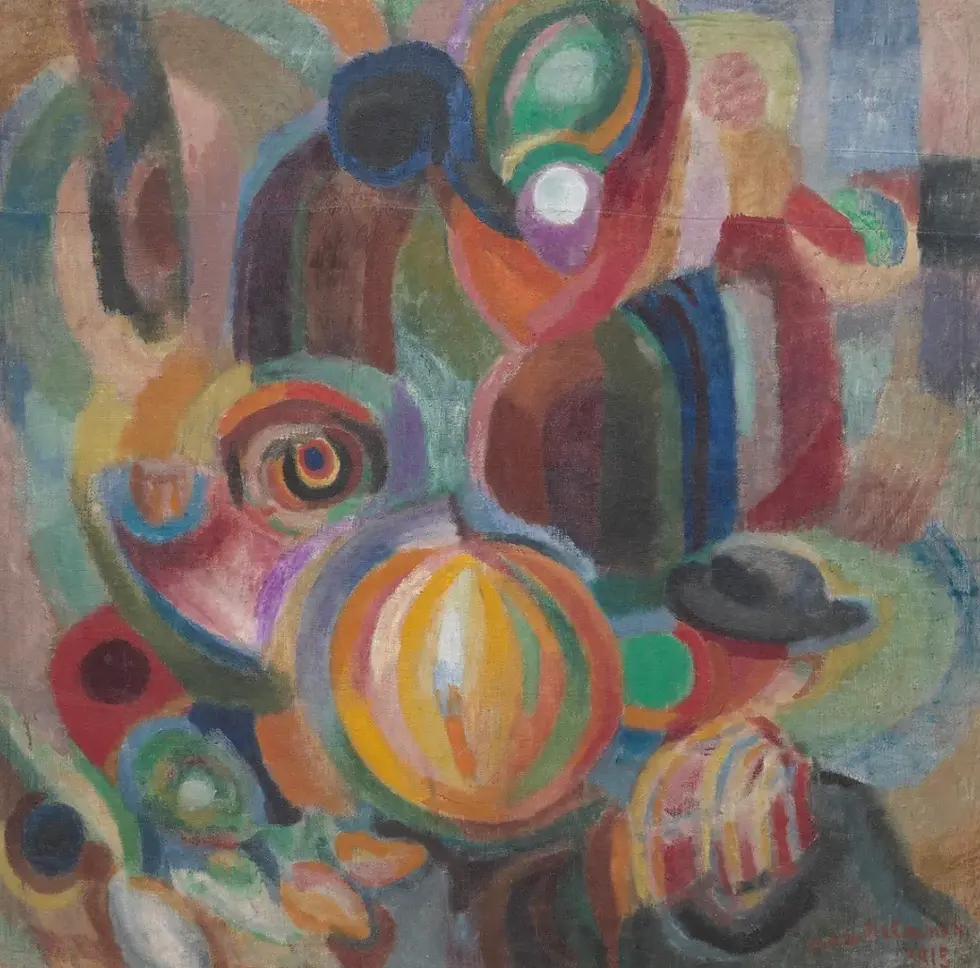
One Painting: Portuguese Market, 1915
Yesterday, we published the full piece on Sonia Delaunay, her colour theory, the 1925 Exposition, and why her paintings and textiles ended up in different kinds of museums. Portuguese Market is one of the paintings from early on in her career.
In 1915, Sonia Delaunay was living in Portugal, after her family had been caught in the Basque country at the outbreak of the First World War. Portuguese Market was painted there, and the painting shows what southern light and Portuguese market life did to her palette. The composition presents a marketplace through semi-abstract blocks of red, blue, green, and yellow. Stalls, figures, and architectural structures are suggested through geometric shapes in different colours.
The painting is oil and wax on canvas, the wax giving the surface a slightly matt quality distinct from just oil paint, which absorbs more light than it reflects. It measures 90.5 cm square and is in the collection of MoMA in New York.
What’s interesting about Portuguese Market in the context of Delaunay’s wider practice is that it is an example of her exploration of simultanism, sitting somewhere between pure colour experimentation, and a response to the world she was living in. Yesterday’s article describes her Iberian years as producing a warmer, more saturated palette than her pre-war Paris work, and this painting is evidence for that claim. The Portuguese market was a real subject turned abstract by Delaunay’s simultanism, and she used it to investigate colour and observation alongside each other.
The same is true of her work Bal Bullier, another painting of a real place, with real density that she explores through colour relationship and that was one of the subjects of yesterday’s article.


Comments