Sonia Delaunay: Colour, Cloth, and the Woman the Art Deco Moment Couldn’t Contain
The Quilt
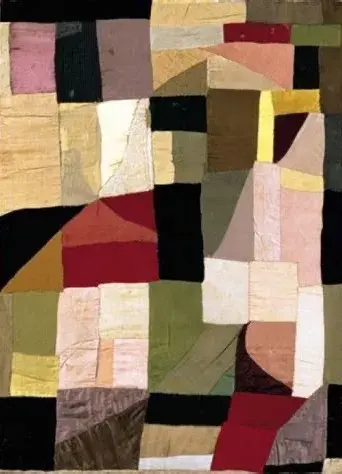
In 1911, Sonia Delaunay made a patchwork quilt for her newborn son Charles. She assembled it from scraps of fabric in the way she remembered from Ukrainian peasant houses, placing pieces of different colours next to each other without a plan for how they would come together. When it was finished, she noticed how the colours were affecting each other: each patch was changing how the ones around it looked, making them more intense than they would have been against white.
What she had discovered for herself was Chevreul’s colour theory, a realisation the blanket allowed her to make. She later described it as evoking cubist conceptions, which was her understanding of that in the context of the language of 1911 Paris. The quilt is now in the collection of the Musée National d’Art Moderne in Paris, filed under applied arts.
Life Before Paris
Sonia Delaunay had been born Sarah Stern in 1885 in Gradizhsk, Ukraine, then part of the Russian Empire, to a poor Jewish family. At the age of five she was sent to live with her mother’s brother in St Petersburg. He was a prosperous lawyer called Henri Terk, and he eventually adopted her. She grew up as Sonia Terk, with access to the Hermitage, summers in Finland, and an education that took her first to the Academy of Fine Arts in Karlsruhe in 1903, and then Paris in 1905, where she enrolled at the Académie de la Palette in Montparnasse and spent more time in galleries than in class.
Paris in 1905 was full of Cézanne, Van Gogh, Gauguin, and the Fauves. In 1908 she married the German art dealer Wilhelm Uhde in a marriage of convenience, giving her French residency and access to her dowry, whilst giving Uhde cover for his homosexuality. It was through Uhde that she met the French painter Robert Delaunay in 1910, and the same year she divorced Uhde and married Robert instead. Their son was born in January 1911, which led to her realisation of colour theory through the quilt.
Adjacent Colours
Michel-Eugène Chevreul was a French chemist who spent most of the nineteenth century studying colour. His 1839 treatise, De la loi du contraste simultané des couleurs, established that the perceived colour of any given area is affected by the colours adjacent to it: grey placed next to red will appear to have a green tinge, because the eye compensates for the red by generating its complement. This isn’t an optical illusion but more of an understanding of how our vision actually works. Chevreul’s theories had already fed into Pointillism through Seurat who was working from them directly, and the Impressionists had applied them intuitively without knowing the science, much as Delaunay had with the blanket.
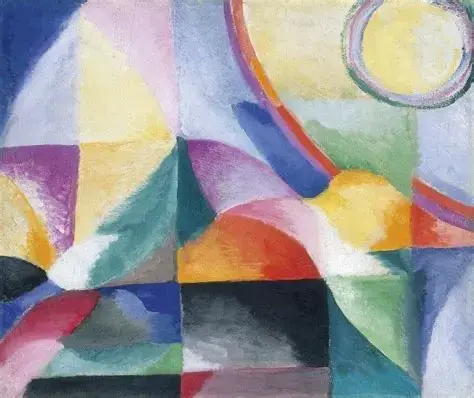
Sonia and Robert Delaunay understood from the quilt the relationship between adjacent colours before either of them encountered Chevreul’s theory. They saw that our interpretation of colour shifts depending on the size of the patches, their hues, the lighting conditions, and the distance from which they are viewed, and in 1912 they formalised this into a practice they called simultanism.
Simultanism was the use of contrasting colours placed in direct relationship so that the interaction between them, rather than any individual colour or form, is the subject of the work. Guillaume Apollinaire, the poet and critic who was a regular presence in their circle, named this Orphism in 1912. This became a useful term for journalists, but also implied a unity of approach between Sonia and Robert which was not always accurate.
Bal Bullier
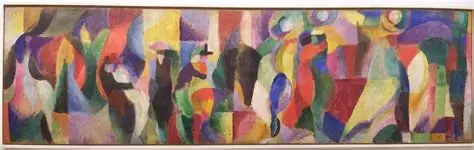
In 1913, Sonia painted Bal Bullier, a large canvas depicting the dance hall on Boulevard du Montparnasse that she and Robert visited regularly. The painting is 97 by 336.5 centimetres, almost eleven feet wide. The Bal Bullier was where Paris came to dance the tango, and the painting portrays it through concentric circles of contrasting colour that pulse and shift as the eye moves across the surface. At the centre are abstracted couples in a tight embrace.
The same year she painted Bal Bullier, she made herself a simultaneous dress, a patchwork garment in contrasting colours, worn to the dance hall so that she and Robert became moving extensions of the paintings they had been producing. She later said that wearing the dress to the Bal Bullier was the moment she understood that simultanism didn’t only belong on canvas.
Spain, Portugal, and the Russian Revolution
At the outbreak of the First World War, the Delaunays were in the Basque country on the French-Spanish border. They did not return to France until 1921, and their years in Spain and Portugal were years of material difficulty. The Russian Revolution in 1917 meant that they were cut off from their income from the Terk family estates in St Petersburg, but the palette that emerges after the Iberian years is very different from the cooler northern colours of their pre-war Paris work, the new colours were warmer, more intense, and saturated.
To help support the household, Sonia opened a fashion and interior design boutique in Madrid called Casa Sonia in 1918. The same year, Sergei Diaghilev commissioned her to design costumes for his Ballets Russes production of Cléopâtre in London, and the dancers wearing Delaunay’s colours on stage at Covent Garden meant that simultanism reached people who would never visit a Paris gallery.
Colour Palettes
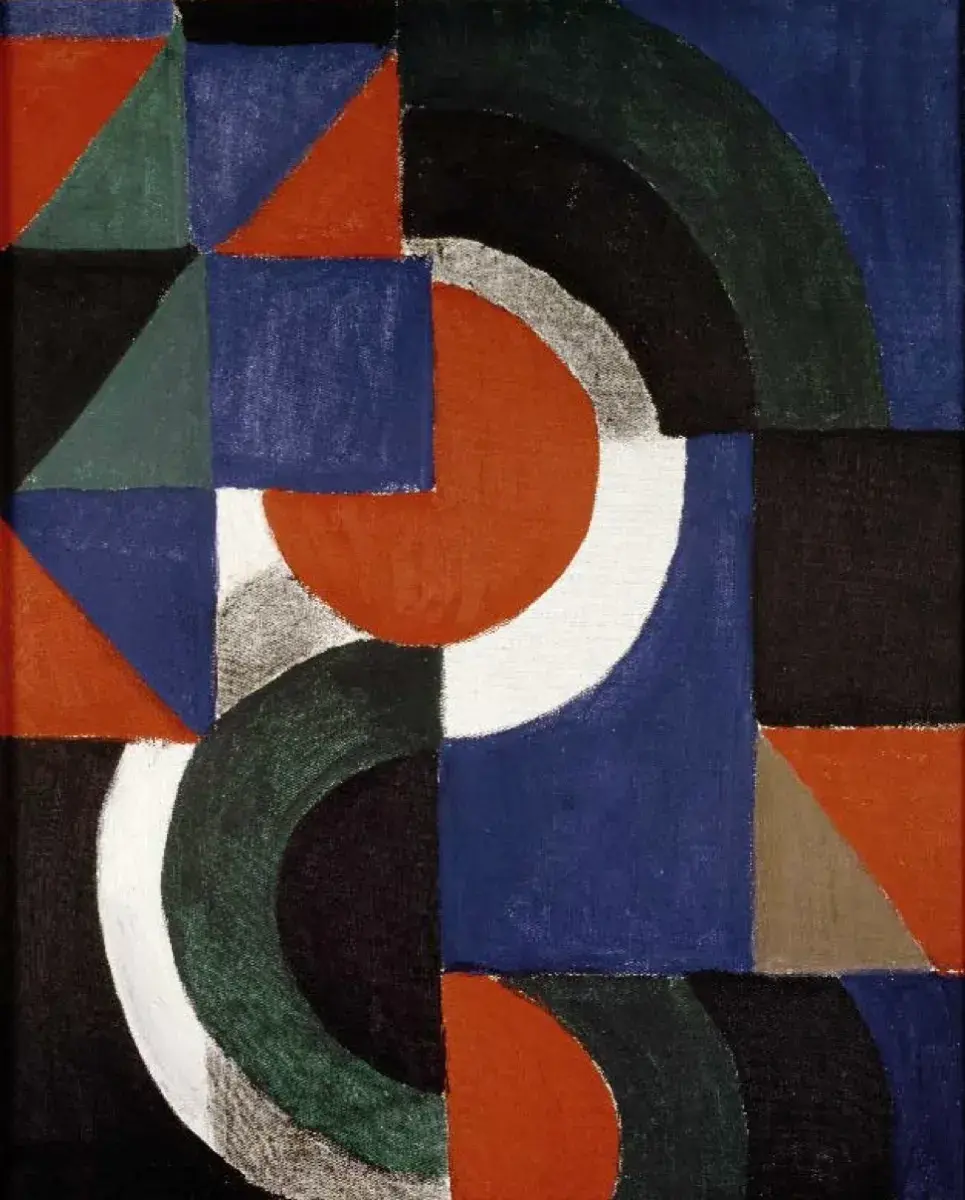
Sonia Delaunay’s palette runs from the cool through to the warm, and what she does with the transitions between them photographs somewhat poorly, this causes the contrasts in reproductions to read as flat and graphic, which is why her work is sometimes dismissed as decorative. When viewing the actual work, the contrasts in the colours generate optical movement, appearing to shift as you move in relation to them.
Chevreul described this effect as simultaneous contrast, where the eye, when presented with two adjacent colours, adjusts its response to each in relation to the other. Delaunay understood that this adjustment also varies with the size of the patch of colour, its exact hue, and saturation, as well as the conditions under which they are viewed. She understood that this wasn’t just a fixed effect to be reproduced with each work, and from the 1911 quilt through to the simultaneous dresses, Bal Bullier, the fashion work of the 1920s, and the late paintings, each body of work is a different configuration of the same set of variables she set out to test.
The Boutique Simultané
At the 1925 Exposition Internationale des Arts Décoratifs in Paris, Sonia opened the Boutique Simultané with the furrier Jacques Heim and the leather goods manufacturer Girau Gilbert. There, she displayed coats, fabrics, scarves, and accessories in her simultanist palette, and commissioned photographs of models wearing her designs against the modernist buildings of the exposition. The boutique was both a commercial and critical success, and she licensed her fabric designs internationally. In Britain, her work was sold through Liberty in London, her geometric forms in strong contrasting colours sitting well in the department store which was already known for bringing continental design to the UK.
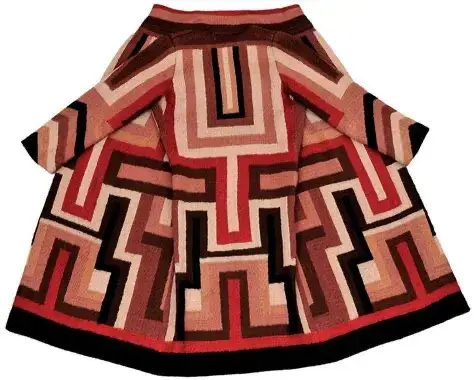
The coat she made for Gloria Swanson in 1923 or 1924, is the individual object from this period that most effectively demonstrates the impact of Delaunay’s fashion work. Swanson was one of the most photographed women in the world at the time, and the coat, made of wool and embroidered with geometric shapes in reds, browns, and creams, displayed simultanism in a way that was legible even for those that knew nothing about colour theory.
Fitting In
The Art Deco moment could accommodate Delaunay’s fabrics and fashions because they were commercially successful and her visual language suited the period’s interest in geometric abstraction and bold colours, but it could not accommodate the way that Sonia’s practice was seemingly unable to recognise the boundary between fine art and applied design that the art world at the time was built around.
The 1925 Exposition itself was also organised around this distinction. There were separate pavilions for fine art and for decorative art, with decorative arts understood to be the junior category which was dependent on the fine arts for its forms and ideas, and distinguished from them by their utility and commercialism. Ruhlmann’s furniture was decorative art of exceptional quality and was celebrated as such. Sonia’s coats and textiles were of the same quality, but she did not accept the view that this placed them in a different category from her paintings.
The history of modern art in the first half of the twentieth century is divided by the enforcement of these boundaries and separations, with those on the ‘wrong’ side of it receiving proportionally less critical attention and museum space than their contemporaries on the other. The boundary asserted itself despite efforts to dissolve it by artists like Sonia Delaunay who refused to acknowledge it, or by movements like the Bauhaus that insisted on craft being the basis of all artistic production, and it had more of an effect on the work of women than the work of men.
The difference can be seen in the Delaunays works. Robert Delaunay’s paintings are very much established and shown in art galleries across the world, while Sonia’s are less consistently there, and her applied work in textiles, fashion, and interiors, is housed in design museums rather than art galleries, proving that the legacy of this boundary is still there.
The Later Work
With the economic crisis of the late 1920s and early 1930s, Sonia’s fashion business contracted. She returned more fully to painting and joined the Abstraction-Création group in 1931, a loose association of abstract artists including Mondrian, Arp, and Hélion among others. She and Robert collaborated on large murals for the 1937 Paris Exposition Internationale, and they continued to work together until Robert’s death in 1941.
After her husband’s death, Sonia continued to work, painting, making tapestries, producing prints and artist’s books, for nearly four more decades. In 1964, following a donation of 117 works by herself and Robert to the French state, she became the first living woman to have a retrospective at the Louvre. She was awarded the Légion d’Honneur in 1975, promoted to Officer, and she died in Paris in December 1979 aged ninety-four.
Her later work, the Rythmes series and the work that followed, is less well known than the pre-war paintings and 1920s fashion. They are large canvases with fewer colours and more space between them than her earlier works, making them less demonstrative of the simultanism she was known for.
Further Research
Reading
Jacques Damase, Sonia Delaunay: Fashion and Fabrics (Thames & Hudson, 1991) is the most comprehensive account of the applied design work, with extensive reproductions of the textile designs and fashion photographs.
Stanley Baron and Jacques Damase Sonia Delaunay: The Life of an Artist (Thames & Hudson, 1995) covers the full career, drawing on Delaunay’s own unpublished journals.
For the theoretical context of simultanism, the best short account is in the Smarthistory essay on Delaunay and simultanism, available free at smarthistory.org. For the primary source, Chevreul’s De la loi de contraste simultané des couleurs (1839) is available in English translation as The Principles of Harmony and Contrast of Colours(Reinhold, 1967).
Whitney Chadwick, Woman Artists and the Surrealist Movement (Thames & Hudson, 1985) covers the broader context of women working in the Parisian avant-garde of the period, though its focus is Surrealism rather than Orphism.
Marcia Pointon, Portrayal and the Search for Identity (Reaktion, 2013) addresses some of the questions about identity, naming, and authorship that Delaunay’s career raises, though not Delaunay specifically.
Visit
The Centre Pompidou in Paris holds the largest collection of Sonia Delaunay’s work, including Bal Bullier, the 1911 quilt, and a significant number of the simultaneous paintings. Note that the Centre Pompidou is currently closed for renovation and is not expected to reopen until 2030.
The Tate Modern in London holds several significant works and has covered Delaunay’s career in major retrospectives, most recently in 2015. Their collection is viewable online at tate.org.uk.
The Museo Thyssen-Bornemisza in Madrid holds Simultaneous Dresses (The Three Women) (1925) and several works from the simultanism series. The museum also holds significant work by Robert Delaunay, and seeing both in the same building is useful for understanding the similarities and differences between their approaches.
The Cooper Hewitt, Smithsonian Design Museum in New York has a strong collection of Delaunay’s textile designs and fashion work, including documentation of the Gloria Swanson coat. Their online collection is searchable at collection.cooperhewitt.org.
Image Credits and Sources
Image Credits
Musée National d’Art Moderne, Centre Pompidou
Museo Thyssen-Bornemisza
Cooper Hewitt, Smithsonian Design Museum
Sources
On the quilt and early biography: The account of the 1911 quilt, its construction from Ukrainian fabric scraps, and Delaunay’s description of it as “evoking cubist conceptions” is documented in Stanley Baron and Jacques Damase, Sonia Delaunay: The Life of an Artist (Thames & Hudson, 1995), which draws on Delaunay’s own unpublished journals. The quilt’s current location in the Musée National d’Art Moderne, filed under applied arts, is confirmed by the Centre Pompidou collection online (collection.centrepompidou.fr). The biographical details: birth name Sarah Stern, born in 1885 in Gradizhsk, adoption by Henri Terk, education in Karlsruhe and Paris, are confiemd by the ArtDeco.org biography (artdeco.org/sonia-delaunay-innovation-interwar-years) and the Britannica entry on Delaunay (britannica.com/biography/sonia-delaunay).
On Chevreul and simultanism: Michel-Eugène Chevreul’s 1839 treatise is available in English translation as The Principle of Harmony and Contrast of Colours (Reinhold, 1967). The account of Chevreul’s influence on Seurat and Pointillism is confirmed by multiple art history sources including the Smarthistory essay on simultanism (smarthistory.org). The formalisation of simultanism by 1912 and Apollinaire’s naming of it as Orphism in 1913 are confirmed by the Tate Modern exhibition documentation for the 2015 Delaunay retrospective (tate.org.uk) and the ArtDeco.org biography.
On Bal Bullier: The painting’s dimensions (97 x 336.5cm), its date (1913), and its current location in the Musée National d’Art Moderne are confirmed by the Centre Pompidou collection record. The account of the simultaneous dress worn to the Bal Bullier is documented in Baron and Damase The Life of an Artist and the Tate retrospective catalogue.
On Spain, Portugal, and the Russian Revolution: The Delaunay’s presence in the Basque country at the outbreak of the First World War, their return to France in 1921, the Russian Revolution cutting off the Terk family income, the opening of Casa Sonia in Madrid in 1918, and the Diaghilev commission for Cléopâtre are all confirmed by the ArtDeco.org biography and Baron and Damas, The Life of an Artist.
On the Gloria Swanson coat and the Boutique Simultané: The Boutique Simultané’s co-founders (Jacques Heim and Girau Gilbert) and its presentation at the 1925 Exposition are confirmed by the ArtDeco.org biography and the Tate retrospective documentation. The Gloria Swanson coat’s date (1923-24), materials (wool, embroidery), and current documentation are confirmed by the Cooper Hewitt, Smithsonian Design Museum collection (collection.cooperhewitt.org). The Liberty London connection is confirmed by Jacques Damase, Sonia Delaunay: Fashion and Fabrics (Thames & Hudson, 1991), the Tate retrospective press release (tate.org.uk/press/press-releases/ey-exhibition-sonia-delaunay), and the University of the Arts Library catalogue entry citing Damase.
On the 1925 Exposition and the fine art/decorative art distinction: The structure of the Exposition’s pavilions, and Ruhlmann’s position within it, are confirmed by Ghislaine Wood Art Deco 1910-1939 (V&A Publications, 2003) and the Musée des Arts Décoratifs documentation.
On the Abstraction-Création group: Sonia and Robert Delaunay’s membership from 1931 is confirmed by Britannica, the ArtDeco.org biography, and the Ben Uri Research Unit biography (benuri.org). The group’s membership including Mondrian, Arp, and Hélion is confirmed by the Ketterer Kunst gallery record (kettererkunst.com) and the Arp Museum exhibition catalogue Network Paris (arpmuseum.org).
On the later career: The donation of 117 works to the French state and the subsequent Louvre retrospective in 1964 are confirmed by the ArtDeco.org biography and Britannica. The Légion d’Honneur (1975, Officer grade) and date of death (December 1979, aged ninety-four) are confirmed by Britannica and the Ben Uri Research Unit.
Closing Note
Sonia Delaunay started a quilt in 1911, and continued to develop her artistic work until the late 1970s. Across these years she created Simultaneous Dresses, Bal Bullier, the Boutique Simultané, coats for Gloria Swanson, fabrics licensed to Liberty and other department stores worldwide, and then, after her husband’s death, nearly four decades of paintings that are less known today.
Throughout her years of work, she was constantly expected to decide whether she was an artist or a designer. The strict categories imposed on her work could not fit it all under just one umbrella, and she resisted the labels anyway, working until she was ninety-four. Today most of her work is found in design museums rather than art galleries, and perhaps we should consider for ourselves if that is where it truly belongs.
If someone forwarded you this, you can subscribe here. Thoughts, corrections, or a Delaunay fabric you want to tell me about: reply to this email. I read everything.


Comments